
Stablecoin treasury platform Velocity has raised $38 million in a Series A funding round to expand infrastructure that helps enterprises and financial institutions use stablecoins for cross-border settlement and treasury operations.
The funding round was led by Dragonfly and FirstMark, with participation from Activant Capital, Capital One Ventures, QED Investors, Coinbase Ventures, Wintermute Ventures and Ripple. Velocity said it plans to use the capital to expand its banking and payments network, develop new products and strengthen its regulatory capabilities.
Founded in 2025, Velocity develops software that connects stablecoin networks with banking, custody, compliance and settlement systems. The company targets enterprise finance teams, payment providers, fintech firms and financial institutions using stablecoins for cross-border payments and treasury operations.
The latest financing brings Velocity’s total funding to nearly $50 million since it launched in 2025, according to the company.
Related: JCB signs Circle MOU to test stablecoin payments in Japan
The funding comes as competition in the enterprise stablecoin market intensifies. In June, more than 140 companies backed the launch of Open USD (OUSD), a dollar-pegged stablecoin supported by companies including Visa, Mastercard, Coinbase and Ripple.
Stablecoin infrastructure investment accelerates
Investment in stablecoin infrastructure has accelerated this year as companies build the software and network infrastructure supporting payments, settlement and enterprise financial services.
In March, Tether participated in a $5.2 million funding round for Ark Labs, a startup building infrastructure for stablecoin issuance and settlement on Bitcoin. The company is developing a programmable execution layer to enable faster payments and more complex financial applications on the network.
Later that month, OpenFX raised $94 million in a Series A funding round to expand its stablecoin-based foreign exchange network, which is designed to speed up cross-border payments for businesses. The company said it would use the capital to expand into Southeast Asia and Latin America while increasing liquidity across its network.
Trace Finance secured $32 million the following month to expand its cross-border payment infrastructure, which combines banking, foreign exchange and stablecoin settlement services for businesses operating across multiple markets.
The investments come as stablecoin payments continue to expand. And a joint analysis by McKinsey and Artemis Analytics estimated that stablecoins processed $390 billion in annualized real-world payments in 2025, including about $226 billion in business-to-business transactions.
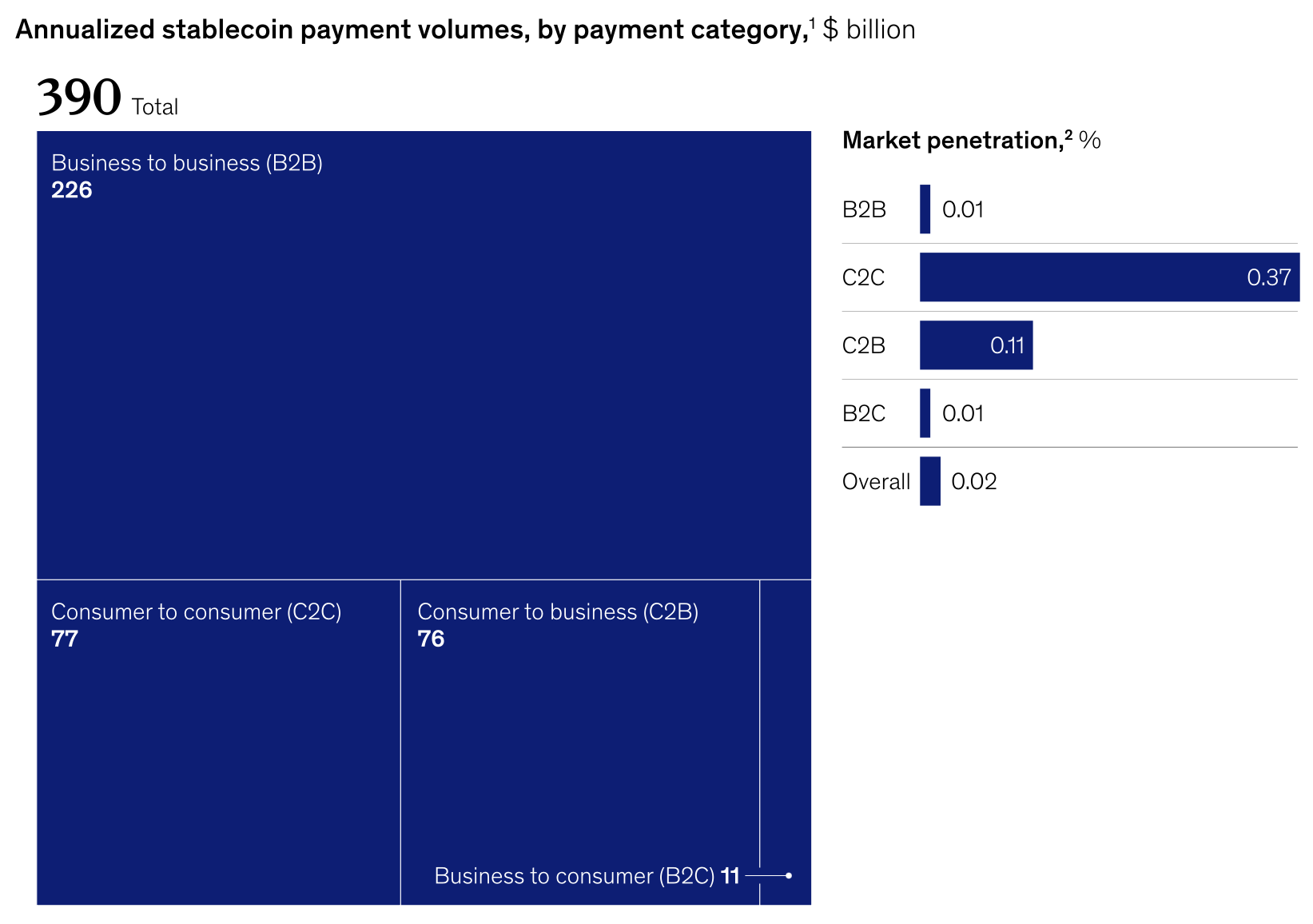
Annualized real-world stablecoin payment volume by use case. Source: McKinsey, Artemis Analytics
Magazine: UK government defers capital gains on certain crypto with ‘no gain, no loss’ approach