
Samuel Huntington is making a comeback.
In his 1996 book The Clash of Civilizationsthe American political scientist deeply divided academic opinion by arguing that culture, rather than ideology, would drive post-Cold War conflicts. In 2019, the British political theorist Christopher Coker wrote that the contemporary concept of the ‘civilisational state’ serves as a real-world evidence of Huntington’s core thesis. According to Coker, culture, rather than ideology, has become the primary currency of international politics.
Indeed, Coker’s observation was the outcome of the increasing use of the term ‘civilisational state.’ But it was originally coined by American political scientist Lucian Pye in 1990. He viewed China not as a nation state in the European tradition but rather “a civilization pretending to be a nation state.”
In 2009, the British academic Martin Jacques wrote that the West continues to misread China by treating it purely as a nation state. He asserted that China must be understood as a civilizational state with different cultural values compared to those of the West. So what exactly is a civilizational state?
As the post-Cold War order fragments, countries such as China, India and Pakistan are increasingly defining themselves not as nation states but as heirs to ancient civilizations.
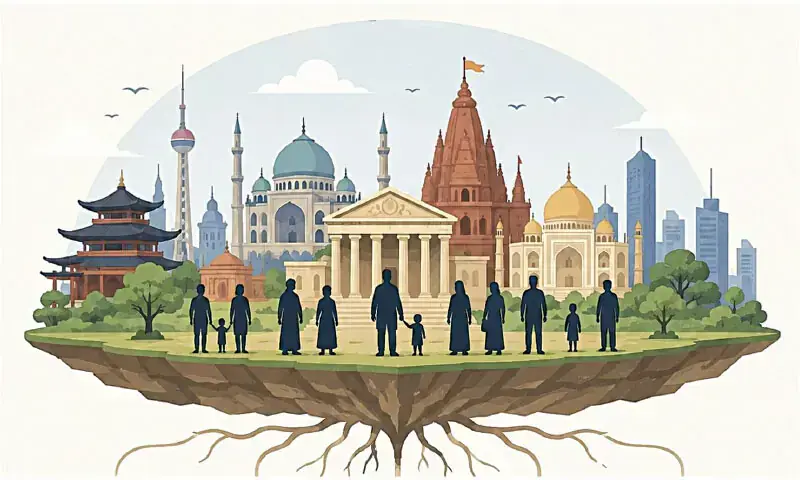
Briefly put, it is a country that claims to represent not just a specific territory or linguistic group, but an entire, distinct civilization. It stands as the antithesis of the standard nation state. The latter was a European concept, where political borders are designed to align neatly with a single national identity.
The idea of the nation state is barely three-and-a-half centuries old. It dominated the 20th century. Yet, this does not mean that the concept of the civilizational state is older. In fact, the term did not even appear until the 1990s.
Today, a growing number of countries, most notably China, Russia, India, Turkey, Iran and Egypt, are framing their identities as civilizational states. Ancient sites that were exhibited as detached pasts, are being reclaimed beyond exhibits for tourists.
As the old international system recedes in the face of a shifting global order, more and more nation states are gradually beginning to redefine themselves through a civilizational lens. This trend signals a vital swing in global politics. It is a direct symptom of a fragmenting global order, marking our transition into an increasingly multipolar world.
Following the end of World War II in 1945, global power was split into a bipolar configuration, dominated by the Soviet Union on one side and the United States on the other. While the Soviet Union sought to expand its sphere of influence by proliferating communism, the US pushed back by championing capitalism and liberal democracy.
This bipolar order finally collapsed with the crash of the Soviet Union in 1991, giving rise to a unipolar world, where the US stood unchallenged as the world’s sole superpower. This is when the Western model of the nation state reached its zenith. By the early 2000s, however, the model began to falter. Democracy failed to take root across various former dictatorships that had adopted it.
Compounding this decline was the fact that democracy within its Western heartland began to face a serious crisis of legitimacy. This was laid bare by the devastating impact of the 2008 financial crash. This triggered the global rise of populism. Indeed, it emerged through the ballot box, but manifested as a demagogic indictment of struggling democracies. Populists eagerly adopted the concept of the civilizational state.
Viewing standard democratic mechanisms as incapable of addressing local crises, populist movements rejected ‘universal truths.’ They rebranded their countries as the modern custodians of ancient civilizations, asserting that their laws and values were products of a unique social, economic and political DNA.
So, the question arises, is a civilizational state inherently a right-wing idea?
Not really. Its content is determined by those who steer it. At its core, the concept merely argues that governance should be rooted in a nation’s historical DNA, rather than imposed through a universalist, ‘Western-centric’ lens.
When rightists embrace it, they use it as a defensive bulwark to manufacture ‘cultural purity’ and insulate themselves from international human rights standards, and enforce nativist policies. In their hands, the ‘civilisation’ becomes a regressive artefact, used to police boundaries. Examples of this include Narendra Modi’s India, Benjamin Netanyahu’s Israel, Donald Trump’s Make America Great Again (MAGA) base, and various electorally influential far-right parties in Europe.
The same civilizational framework has been used by progressive post-colonial thinkers as well. They use it to dismantle the legacy of ‘cultural imperialism.’ To them, indigenous, non-Western systems and values are legitimate and often more authentic and egalitarian.
The distinction between the two is in whether one treats their civilizational heritage to exclude others, or as a foundation upon which to build a more dynamic multicultural society that fits within the framework of a civilization.
Pragmatism forms the third pillar. For example, China perceives itself as a civilization anchored in centuries of realistic, flexible statecraft that has preserved its continuity through multiple global changes.
Pakistan is now also increasingly adopting a similar civilizational identity. It seeks to loosen the grip of the rigid, state-imposed ideology that it shaped after 1971. It was a framework that ultimately fueled ethnic and sectarian polarization and was becoming too inflexible to help Pakistan navigate a rapidly evolving multipolar world.
Pakistan is gradually planting its foundational roots back in South Asia. The country’s military triumph against India in 2025, the rise of Hindu nationalism in India, and the manner in which Pakistan’s status recently surged in international relations, provided the state a sense of freedom to maneuver outside ideological rigidity and increasingly adopt pragmatism.
It has begun to construct a new national narrative that explains multicultural Pakistan as part of a chain of civilizations that emerged along the Indus, the country’s largest river. This means that Pakistan is ‘reclaiming’ these civilizations cut across 5,000 years.
India sees these civilizations as inherently ‘Hindu’, at least until the proper entry of Muslim dynasties in South Asia from the 13th century onwards. But India can’t ignore the fact that Indus civilizations are all located in what today is Pakistan.
Also, according to the noted Indian historian Romila Thapar, the term ‘Hinduism’ as a uniform religion is itself a modern construct. She suggests that pre-colonial India contained an overlapping set of religious sects and practices that were collated into a uniform ‘Hinduism’ by British colonialists to fit Western, Abrahamic definitions of what a ‘religion’ should be.
The rise of the civilizational state marks a departure from the post-Cold War unipolar era, signaling that the West’s experiment in universalising its specific model of the nation state has reached its limits. Whether this shift heralds a more pluralistic world order, or a new age of insular, identity-driven conflict, remains to be seen.
Published in Dawn, June 21st, 2026