
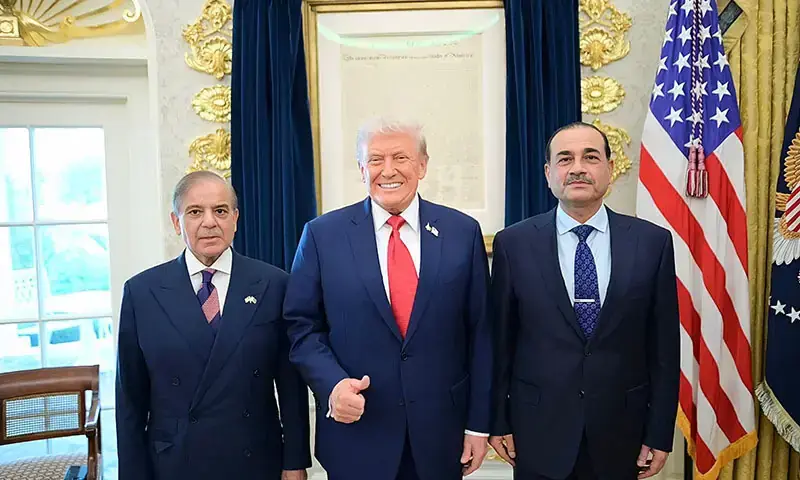
Prime Minister Shehbaz Sharif on Sunday hailed United States President Donald Trump’s “extraordinary efforts to pursue peace”, saying the latter held a “very useful and productive call” with multiple countries’ representatives, including Chief of Defense Forces and army chief Field Marshal Asim Munir.
Trump held a phone call on Saturday with the leaders of Saudi Arabia, Qatar, Turkey, Egypt, the United Arab Emirates (UAE), Jordan and Pakistan.
The leaders encouraged Trump to agree to the emerging framework, Axios reported.
In a post on Truth Social, Trump said he had a “very good call” with Saudi Arabia’s crown prince; the presidents of the UAE, Turkey and Egypt; Qatar’s emir, prime minister and a minister who is part of the Board of Peace; and the kings of Jordan and Bahrain.
A call with Israeli Prime Minister Benjamin Netanyahu also went “very well”, Trump noted.
Subsequently, in a post on X, PM Shehbaz said CDF Munir represented Pakistan in the call with Trump, appreciating the field marshal’s “tireless efforts during the entire process”.
“The discussions provided a useful opportunity to exchange views on the current regional situation and how to move the ongoing peace efforts forward to bring lasting peace in the region,” the premier said.
“Pakistan will continue its peace efforts with utmost sincerity and we hope to host the next round of talks very soon.”
Deputy Prime Minister and Foreign Minister Ishaq Dar commended the US president’s leadership and “commitment to dialogue and diplomacy”, saying the call marked a “significant step closer towards the shared objective of regional peace, stability, and an early diplomatic outcome”.
In a statement on X, the deputy prime minister commended PM Shehbaz’ “visionary leadership” and CDF Munir’s central role in the mediation process.
He also appreciated the rest of the US team, including Vice President JD Vance, Secretary of State Marco Rubio, special envoy Steve Witkoff and adviser Jared Kushner for their sustained engagement.
In addition, he appreciated the constructive engagement of the Iranian leadership, naming President Masoud Pezeshkian, Foreign Minister Abbas Araghchi and Speaker Bagher Ghalibaf. He also praised the efforts of United Nations chief Antonio Guterres as well as “our brotherly regional partners and all other countries, with whom I remained closely engaged throughout this process”.
“Dialogue and diplomacy must prevail over conflict and confrontation for the collective prosperity and security of our region and beyond,” he said.
Pakistan is continuing its efforts to revive the stalled Iran-US peace process after plans for a second round of negotiations in Islamabad fell through.
The first round of historic direct US-Iran talks was held in Islamabad on April 11 and 12, following a Pakistan-brokered ceasefire on April 8. It had ended without an agreement, but also without a breakdown.
Trump later called off a planned visit by US Special Envoy Steve Witkoff and adviser Jared Kushner to Islamabad for a second round of talks with Iran. However, he extended the ceasefire indefinitely “upon the request of Field Marshal Asim Munir, and Prime Minister Shehbaz Sharif”.
The latest round of contacts is taking place under heightened pressure from the US and its Middle East allies. Trump on Wednesday said talks in Iran were in the final stages, and also threatened to resume strikes if a deal is not reached in a “limited timeframe”.
Then, this weekend, he said that a memorandum of understanding on a peace deal had been “largely negotiated” with Iran and would open the Strait of Hormuz, with details to be unveiled soon.
Pakistan has stepped up its diplomatic efforts to break the deadlock in the US-Iran negotiations, with CDF Munir concluding a high-level visit to Tehran on Saturday.
In Tehran, he conducted intensive negotiations with the Iranian leadership that resulted in “encouraging progress towards a final understanding”, the Inter-Services Public Relations (ISPR) said in a statement.
US Secretary of State Marco Rubio commented about CDF Munir’s visit, saying that the US was in “constant communication with him.” [and] the highest levels of our government are constantly talking to him”.
He also praised Pakistan for doing an “admirable job” trying to mediate a peace deal between Washington and Tehran.
Interior Minister Mohsin Naqvi also made his Second visit to Iran in less than a week to resuscitate negotiations. The minister had previously Met Iran’s president, parliament speaker and foreign minister over the weekend.
The visits came at a time when negotiations appeared to have moved beyond political signaling into detailed bargaining over a narrow interim framework dealing with the Strait of Hormuz, Iran’s nuclear program, sanctions relief and guarantees against renewed military action.


