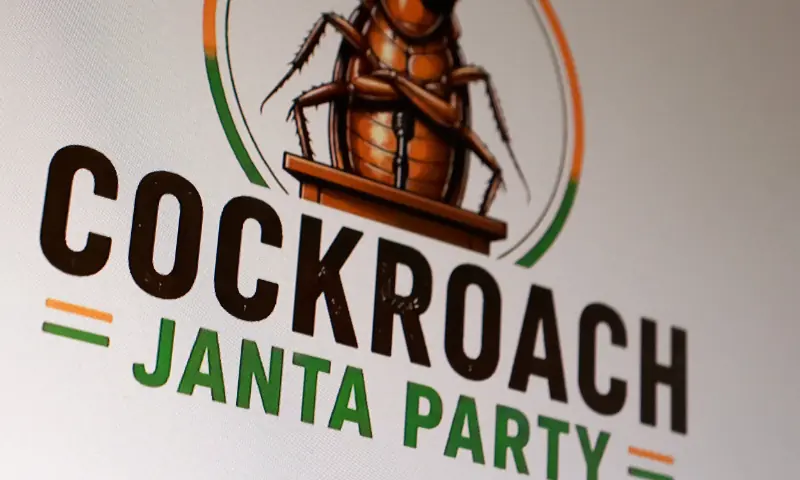
The largest online expression of dissent against Indian Prime Minister Narendra Modi’s 12-year rule began with a satirical riposte to a jibe about young people, triggering death threats to its founder and pushback from ruling party politicians.
The rapid fame of 30-year-old Abhijeet Dipke and his Cockroach Janta Party, which he says represents “the lazy, the unemployed, and the chronically correct”, is driven by the concerns of the youth in a country where those below 30 are estimated to number more than half a population of 1.42 billion.
Political analysts say the group’s enormous popularity has begun to dent Modi’s image, despite his party’s recent victories in key state elections, even as wider frustration grows over rising fuel prices and gas shortages brought by the Iran war.
“If all was well with the country and the economy, 20 million young people would not rally around something like this,” said political activist Yogendra Yadav, who was a top leader of a national movement against corruption in 2011.
“This is a critical moment that tells us something about the state of our polity: underlying all the claims of total dominance, there is a latent but widespread disquiet.”
The 75-year-old Modi has so dominated Indian politics since coming to power in 2014 on the back of massive street protests against government corruption that few analysts expect him to give ground easily to any dissenter.
But the new movement, fueled by persistently high youth unemployment and recurring leaks of examination papers that threaten to derail the careers of millions of students, hints at cracks in a carefully cultivated image of stability and control.
“This is their moment, but they need to walk carefully,” said prominent lawyer Prashant Bhushan, a founding figure of the anti-graft movement.
“If they want to take it forward they will have to organize and then come on the streets protesting on the issues which they have been raising online.”
Without such a presence, the movement risks fizzling out, analysts and supporters said, adding that Modi’s Bharatiya Janata Party, which draws much of its support from India’s Hindu majority, has steadily weakened the opposition.
Critics say its tactics include wielding investigative agencies against senior opposition politicians, but the government has responded by saying authorities had been given a free hand to tackle corruption.
Senior cabinet minister Kiren Rijiju has said Dipke’s group was undermining the world’s biggest democracy by choosing the name of an insect, while accusing it of seeking social media followers from Pakistan and the “anti-India gang”.
Sleepiness nights creating content
In interactions with Reuters from the US, where he has lived for the past two years, Dipke described sleepless nights creating social media content and doing media interviews.
“The Indian government has declared me a national security threat,” he said by telephone from Chicago.
“They are trying to defame me. But democratically, within our constitutional rights, we will do what needs to be done.”
He said he has worked to free his X account from a government block, regain control of his CJP Instagram page from unknown hackers, and ensure the safety of family members in both countries after receiving threats of physical harm on WhatsApp.
Police in the western state of Maharashtra, from which he hails, have assured him that they will ensure his family’s safety, he said.
Dipke has publicly shared data showing about 95 percent of the nearly 23 million followers of the Instagram account are based in India, followed by countries such as the US, home to large groups of overseas Indians.
More than two-thirds of these followers are Gen-Z, born between 1997 and 2007, said Dipke, a public relations strategist, who graduated from Boston University and was a social media intern with India’s opposition Aam Aadmi Party.
“They know I started this as a joke, as satire,” Dipke said. “But the country’s Gen-Z wants me to actually do something. They don’t want this to be just another meme.”
He has challenged the block of the X account in a Delhi court.
X and India’s home and infotech ministries, as well as Modi’s office, did not respond to requests for comment.
“The rise of web blocking in India shows how dissent and satire are being treated not as democratic expression, but as administrative threats,” said Apar Gupta, a lawyer and director of the Internet Freedom Foundation in New Delhi.
Dipke said his followers want him to go beyond memes and he is discussing ways to turn the campaign into a credible movement, but no decision has been made on becoming a political party.
‘What if all cockroaches come together?’
The furore was set off by Dipke’s X post on May 16 that quickly went viral, asking, “What if all cockroaches come together?”
He said the post was a response to comments by India’s top judge, Chief Justice Surya Kant of the Supreme Court, that compared some unemployed youth to cockroaches.
Kant later said he did not mean to criticize young people but was referring to those with “fake and bogus degrees” whom he likened to “parasites”.
CJP adopted a manifesto and took as its mascot the image of a cockroach on a mobile phone.
With its message amplified by Indian social media influencers and content creators, it amassed a massive following on Instagram within days, far outpacing the 9.3 million followers Modi’s BJP has built over more than a decade.
Unemployment in 2025 stood at 3.1pc among those aged 15 and above, government data shows, but in the bracket from 15 to 29 it was much higher, at 9.9pc, and higher in urban areas, at 13.6pc, than the 8.3pc figure in rural regions.
Dipke says this disenchanted group has flocked to his page.
“I have an MBA degree, and I am overqualified for my job and also underpaid,” said Shurin Dixit, a 23-year-old who works in entry-level operations for a tech company in the northern city of Lucknow. “If the group calls for any protest, I am ready to join them.”
CJPs burgeoning popularity has drawn comparisons to deadly Gen-Z-led uprisings in neighboring Bangladesh and Nepal that toppled governments, but Dipke cautioned against such parallels.
He said 70pc of CJP’s followers were younger than 28 and apolitical people who do not align with any party. “They are frustrated with the government over unemployment and the quality of life in India,” he said. “But equally, they are frustrated with the opposition parties too, because the opposition has not done anything substantial to hold the government accountable.”
Taking on entrenched parties with their financial might not be easy, analysts said.
“Physical presence, collecting funds, finding volunteers, these are all major resource-based challenges, said Sanjay Kumar of the Center for the Study of Developing Societies.
Moreover, taking to the streets brings its own risks, as authorities under Modi in the past have clamped down heavily on large demonstrations, with deadly consequences for protesters.
But many well wishers are optimistic.
“I hope they put forth some sort of organizational plan soon, because Gen-Z has a tendency to get over trends as quickly as it gets on them,” said content creator Madri Kakoti, popularly known online for reels questioning the government.