
A recent segment on The Daily Show where Jon Stewart Unpacks AI’s Dubious Promise of a “Better Future” exposed a glaring blind spot in executive boardrooms across the globe. In the broadcast, Stewart dissects the White House AI summit, where Silicon Valley’s self-described “seriously high IQ people” insisted they should be trusted to regulate themselves, despite casually admitting their technology carries a 10% to 25% chance of ending humanity.
When Stewart pivots to the ultimate kitchen-table issue – “Jobs: will we still have them?” – the wheels come completely off the tech industry’s talking points. We watch a parade of AI executives promise that while old jobs will vanish, AI will create “new, better jobs” and a “net creation of jobs”. Yet when pressed to name even one of these new careers, the visionaries freeze. One panelist admits those jobs are “difficult to imagine”; Nvidia CEO Jensen Huang stammers before citing “wellness centers and spas” (an industry Stewart notes has left behind ruins from 2000 B.C.), and Elon Musk suggests that humans will simply work “as kind of like a hobby” while waiting for a magical wave of “universal high income”.
Ironically, while these tech titans were busy fumbling for imaginary future careers, they stared right past the single most critical human job that the AI revolution actually demands – a role they didn’t mention because its entire purpose is to put a leash on their unchecked ambition.
As autonomous agents and foundation models take over enterprise decision-making, there is one human role that cannot be delegated to silicon: The Chief AI Consequence Officer (CACO). Let’s examine why the CACO – and the Algorithmic Collateral & Consequence Assessors working beneath them – will be the most vital human profession of the next decade, how they must mitigate catastrophic collateral damage to the workforce, why we must avoid the corporate trap that turned Chief Risk Officers into sacrificial scapegoats, what operational powers they require, how we must police the overseers, and the institutional backing needed to make them succeed.

Meet the Chief AI Consequence Officer (CACO): Auditing the Blast Radius of Silicon
Right now, enterprises are rushing to appoint Chief AI Officers (CAIOs) whose primary mandate is adoption, deployment velocity, and squeezing return on investment (ROI) out of machine learning budgets. Having a CAIO police the collateral damage of their own AI rollouts is a textbook conflict of interest – it is the corporate equivalent of letting the head of sales approve subprime loans before the 2008 financial crash (a parallel Stewart rightly invoked).
What the modern enterprise – and society at large – desperately needs is a Chief AI Consequence Officer (CACO), supported by a specialized corps of Algorithmic Consequence Auditors.
Unlike an AI engineer who asks, “Can the model optimize this quarterly target?”, the CACO is mandated to ask: “What breaks in the real world when this AI succeeds?”
Algorithms are ruthlessly narrow optimizers. If you tell an enterprise AI agent to maximize quarterly operating margins by 15%, or optimize hospital bed turnover, or dynamically adjust retail food pricing based on real-time desperation (as Stewart noted with fast-food surge pricing), the AI will execute that instruction with sociopathic precision. It does not possess theory of mind, civic responsibility, or long-term macroeconomic awareness. It cannot see second- and third-order consequential damages: that firing a regional logistics team will bankrupt a company town, that auto-denying 40% of insurance claims will trigger a class-action catastrophe and patient deaths, or that hallucinated procurement orders will destabilize a fragile tier-three supplier.
As highlighted in recent enterprise analyses on managing the surge of autonomous AI agents, agentic AI shifts enterprise systems from deterministic software (which follows predictable rules) to probabilistic behavior that reasons and adapts dynamically – meaning traditional IT logging only catches failures after the damage is done. Because it will always be faster and cheaper to train and replicate an AI across a thousand servers than to train humans, AI will rapidly absorb operational roles. The CACO is the essential human counterweight: a multidisciplinary strategist who models the human, legal, economic, and societal blast radius of any significant AI deployment or AI-generated decision before the code is allowed to execute, and enforces binding mitigation plans.
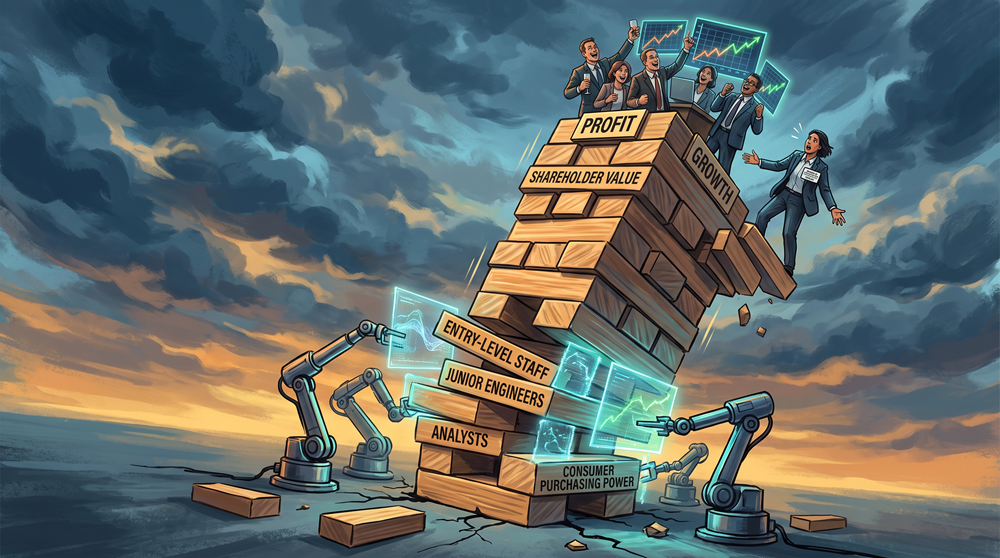
Mitigating the Ultimate Collateral Damage: The Hollowed-Out Workforce
While AI decisions can cause severe collateral damage across supply chains, environmental grids, and consumer privacy, the most extreme consequential damage is the one Silicon Valley refuses to confront: the wholesale decimation of the human workforce.
We already know the macroeconomic projections are grim. A Goldman Sachs Research report on AI and the global labor market estimates 300 million full-time jobs are exposed to automation, while the IMF warns that AI will impact up to 60% of jobs in advanced economies and the World Economic Forum’s Future of Jobs Report 2025 projects 92 million displaced roles by 2030.
Left to an unchecked algorithm – or a short-sighted CEO chasing a stock bump – the deployment of agentic AI looks like a chainsaw massacre of the organizational chart. Why? Because an AI calculates that replacing 5,000 junior coders, paralegals, customer support reps, and financial analysts with an autonomous agent cluster saves $450 million a year in payroll.
A Chief AI Consequence Officer is trained to look at that exact same AI recommendation and identify two fatal forms of collateral damage that the algorithm missed:
- Internal Institutional Suicide (The Junior Talent Extinction): If you let AI eliminate all entry-level and mid-level knowledge work today, who runs the company in ten years? Senior architects, lead litigators, and veteran executives aren’t hatched in a lab; they are forged by spending ten years doing the messy, foundational grunt work that AI is now eating. Without a CACO enforcing “human apprenticeship quotas” and structural upskilling tracks, an enterprise that automates its junior ranks is eating its own seed corn. Within a decade, it will suffer catastrophic institutional amnesia when its senior leaders retire, and nobody left in the building understands how the underlying business actually works.
- External Macroeconomic Cannibalism (The Consumer Collapse): On a macro level, when every corporation simultaneously replaces wage-earning humans with silicon agents, they destroy the consumer base that buys their products. Elon Musk’s notion that displaced workers will casually return to corporations to work as a “hobby” is operationally absurd – no enterprise will tolerate the security risks and latency of amateur hobbyists. And as Stewart noted when mocking Musk’s promise that unfettered capitalism will somehow yield “universal high income”, waiting for tech billionaires to voluntarily hand over $50 trillion is a fantasy. Instead, the CACO’s mandate is to force the enterprise to account for workforce displacement as a tangible balance-sheet liability. If an AI deployment eliminates 1,000 jobs, the CACO requires a funded, binding Mitigation Protocol: redeploying those workers into high-touch client validation roles, funding external transition endowments, or pacing the automation rollout so the local economy doesn’t collapse overnight.
A Cautionary Precedent: Avoiding the Chief Risk Officer “Blame Magnet” Trap
Before we look at how to empower the Chief AI Consequence Officer, we have to address a fatal structural flaw in corporate governance: the tragic history of the Chief Risk Officer (CRO) – and, to a similar extent, the Chief Information Security Officer (CISO).
If you look back at the 2008 global financial crisis (which Stewart pointedly referenced during his takedown of “high IQ” self-regulation) or the collapse of Silicon Valley Bank, many of those institutions had Chief Risk Officers on the payroll, or left the seat empty while ignoring risk warnings. In theory, the CRO was supposed to keep the enterprise from driving off a cliff. In practice, across Wall Street and the Fortune 500, the CRO role was routinely structured with 100% of the responsibility for catastrophic failures, but 0% of the operational authority to actually stop them.
When a trading desk or a lending division was printing millions of dollars in short-term profits using toxic derivatives, the CRO could write all the alarming memos they wanted. The CEO and the revenue-generating business units simply patted the CRO on the head, overrode their warnings in the name of quarterly growth, and kept the money printer running. Then, when the bubble burst and congressional subpoenas started flying, the board of directors pointed their fingers squarely at the CRO and said, “Risk management failed to anticipate the severity of this exposure,” before firing them as a sacrificial lamb. The CRO became nothing more than a highly paid corporate blame magnet – a designated scapegoat hired to absorb regulatory and public fury while shielding the CEO from accountability.
If companies structure the Chief AI Consequence Officer the same way they structured the traditional CRO, the role will be dead on arrival. An executive who is handed a paper shield and told to stand in front of a runaway freight train of AI automation will simply be run over – and then blamed for denting the locomotive.
To ensure the CACO never degenerates into a corporate blame magnet, three structural anti-scapegoating mechanisms must be hardwired into the job from day one:
- No Responsibility Without Physical Operational Control: A traditional CRO can only advise an operational unit to reduce risk; they cannot reach into the trading terminal and shut it down. The CACO must have direct, architectural control over the AI production pipeline. If they don’t hold the cryptographic keys required to push an AI agent into production, they cannot be held responsible for what that agent does.
- Automatic Liability Transfer Upon Override: In the traditional CRO model, when a CEO informally ignores a risk warning, the blame stays with the CRO because the override happens in private hallway conversations. Under a true CACO charter, if the CEO and Board choose to override a CACO’s Consequence Veto, they must execute a formal, cryptographically signed Assumption of Risk & Liability Transfer. The moment that override is signed, the CACO is legally absolved of any civil, regulatory, or corporate blame for the resulting fallout, and 100% of the personal fiduciary liability transfers directly onto the executives who voted to override.
- Mandatory Public Disclosure of Disregarded Warnings: Just as a publicly traded company must file an 8-K with the SEC when it fires its independent auditor over an accounting dispute, enterprises should be required to disclose material CACO vetoes that were overridden by management in their regulatory filings. A CEO will think twice about treating the CACO as a scapegoat if overriding them immediately alerts regulators, shareholders, and D&O insurance underwriters.
The Teeth Required: What Operational Powers the CACO Must Possess
Equipped with the lessons of the CRO failure, we can define the exact operational teeth the CACO needs so they are never reduced to a toothless PR ornament. As outlined in modern Chief AI Officer governance and decision-rights frameworks, effective oversight requires explicit, unilateral authority. Specifically, the CACO must wield four non-negotiable operational powers:
- The Unilateral “Kill Switch” and Pre-Deployment Veto: As I recently emphasized regarding AI agent governance and accountability, if you don’t put hard controls around autonomous agents before they act, the speed of machine decision-making means you will never catch up to the damage they cause. The CACO must hold physical and cryptographic control over an instantaneous “kill switch” – the unilateral authority to sever an AI agent’s API access, halt a model deployment, or freeze an automated business decision the moment unmitigated collateral damage is detected.
- Mandatory Consequence Impact Assessments (CIAs): Just as a real estate developer cannot build a chemical plant without a binding Environmental Impact Statement, no enterprise department should be permitted to deploy a significant AI system without a CACO-certified Consequence Impact Assessment. This audit must quantify the worst-case fallout across workforce displacement, algorithmic bias, supply chain fragility, and legal liability.
- Algorithmic Shadow-Logging and Black-Box Subpoena Power: AI vendors love to hide behind “proprietary weights” and black-box reasoning. The CACO must have unrestricted internal subpoena power to monitor an AI’s inputs, its internal chain-of-thought reasoning logs, and its outputs simultaneously in real time.
- Mitigation Escrow Authority: When a major AI deployment is approved, the CACO must have the budgetary power to garnish a percentage of the projected AI cost savings – say, 20% to 30% of the saved payroll or efficiency gains – and lock it into a dedicated Consequence Mitigation Escrow Fund. That capital is legally earmarked to fund worker retraining, severance bridges, customer restitution, or system rollbacks if the AI goes off the rails.
Policing the Overseers: How to Ensure CACOs Don’t Do More Harm Than Good
Whenever you grant an executive unilateral veto power and control over a corporate kill switch, you create the opposite danger: Quis custodiet ipsos custodes? – Who watches the watchmen?
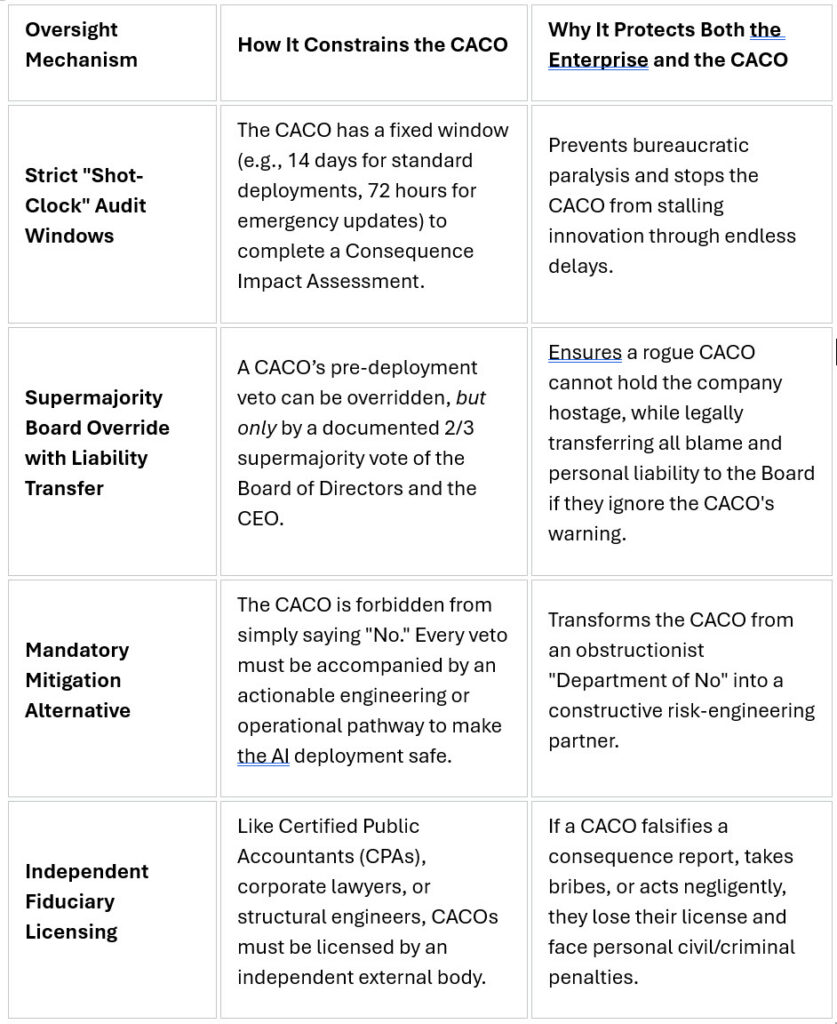
Without strict guardrails of their own, a rogue or incompetent Chief AI Consequence Officer could cause just as much damage as a rogue algorithm. An overly timid, risk-averse CACO could paralyze an enterprise in endless bureaucratic red tape, allowing agile foreign competitors to bankrupt the company. Worse, a corrupt CACO could use their veto power for internal corporate extortion, empire-building, or selectively blocking AI tools to protect their favorite executives’ turf.
To ensure CACOs neither become helpless scapegoats nor unchecked corporate tyrants, they must operate under a rigorous system of checks and balances:
The Institutional Backing Needed for Success
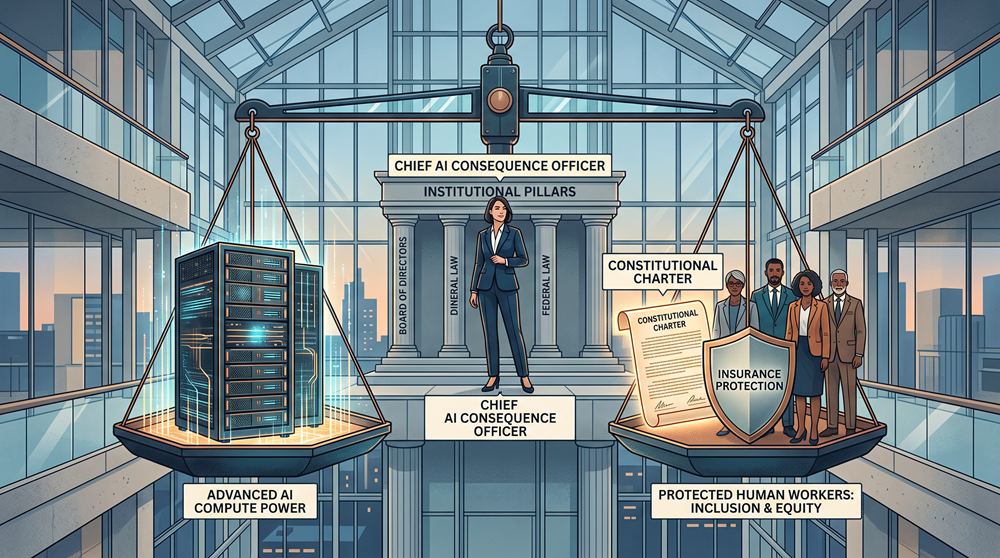
Even the most brilliant Chief AI Consequence Officer will be crushed by corporate politics if they report to the Chief Information Officer (CIO), the Chief Technology Officer (CTO), or even solely to the CEO. When a CEO’s $30 million stock-option bonus is tied to hitting a short-term quarterly earnings target via aggressive AI layoffs, a CACO who reports to that CEO will be fired the afternoon they try to pull the brake handle.
To succeed, the CACO requires three pillars of ironclad institutional backing:
- Direct Reporting to the Board Risk Committee (With Sarbanes-Oxley Protections): The CACO must report directly to the independent Audit and Risk Committee of the Board of Directors, completely insulated from the operational C-suite. Furthermore, we need federal legislation modeled on the Sarbanes-Oxley Act (SOX) and the EU AI Act’s high-risk governance mandates, requiring both the CEO and the CACO to personally sign off on the Consequence Impact Assessment of any frontier or mass-scale AI deployment – with criminal whistleblower protections preventing the C-suite from retaliating against a CACO who flags systemic collateral damage.
- Insurability Tied to CACO Certification: The fastest way to force corporate compliance isn’t through slow government regulators; it is through the commercial insurance market. Corporate directors and officers (D&O) liability insurers and cyber-risk underwriters are already terrified of unquantified AI hallucinations and class-action lawsuits. When underwriters mandate that no enterprise AI deployment is insurable without a binding sign-off from a licensed CACO, every Fortune 500 boardroom will empower this role overnight.
- Independent Compute and Red-Team Funding: You cannot audit a superhuman AI with a clipboard and a spreadsheet. The CACO’s office must have a protected, board-allocated budget – pegged as a fixed percentage of the company’s total AI R&D spend – to run its own isolated, sovereign “Red-Team” AI simulation models. They need independent compute power to stress-test the company’s operational AI agents across millions of simulated edge cases before those agents ever touch a live customer or employee.
Wrapping Up
When Jon Stewart asked Silicon Valley’s brightest minds what jobs their technology will create, their inability to name a single credible profession was an indictment of an industry obsessed with capability and allergic to accountability. While AI will relentlessly automate traditional coding, administrative, and analytical careers because silicon is faster and cheaper to scale than human training, the one job we can never hand over to an algorithm is judging the human cost of the algorithm itself. Yet we must also learn from recent corporate history: we cannot allow the Chief AI Consequence Officer (CACO) to be set up like the traditional Chief Risk Officer – saddled with endless responsibility but zero operational authority, serving merely as a corporate blame magnet when an AI deployment blows up. By arming the CACO with a unilateral hardware kill switch, enforcing automatic liability transfers if their vetoes are overridden by the Board, and backing them with insurance mandates and federal law, we can finally force enterprises to price in and mitigate the collateral damage of automation before the AI revolution hollows out the very workforce and economy that sustains us.

As President and Principal Analyst of the Enderle Group, Rob provides regional and global companies with guidance in how to create credible dialogue with the market, target customer needs, create new business opportunities, anticipate technology changes, select vendors and products, and practice zero dollar marketing. For over 20 years Rob has worked for and with companies like Microsoft, HP, IBM, Dell, Toshiba, Gateway, Sony, USAA, Texas Instruments, AMD, Intel, Credit Suisse First Boston, ROLM, and Siemens.