
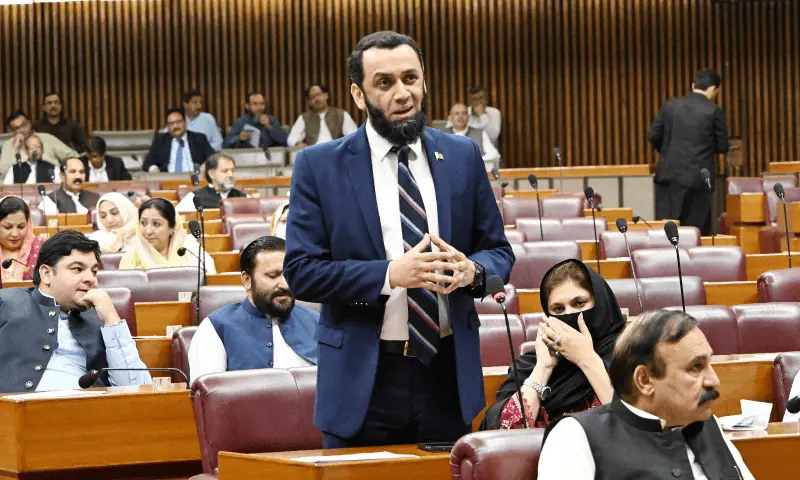
ISLAMABAD: Information Minister Attaullah Tarar on Sunday invited the opposition to sign a Charter of Economy (CoE) and defended the federal budget 2026-27.
Speaking on the floor of the National Assembly on Sunday, Tarar gave credit to the government for what he called “sagacious” economic policy.
“It’s a friendly and relief-oriented budget for all,” he said, noting that the budget has proposed to abolish the super tax, which had been approved by Prime Minister Shehbaz Sharif.
The information minister highlighted that revenue and foreign remittances had increased.
Tarar urged the opposition to appreciate the good decisions made by the government, particularly its efforts for peace in the Middle East. “Today the economy is on the right track,” he asserted.
On June 12, the government presented the budget for FY27, announcing relief measures for the salaried, corporate, real estate and export sectors to revive struggling economic activity.
While the government has placed greater emphasis on enforcement measures rather than introducing new taxes, it has proposed taxes on social media earnings and a fixed tax scheme for small traders and shopkeepers.
Responding to Tarar in the NA, PTI leader Asad Qaiser said the PTI was willing to sign a Charter of Democracy to ensure an independent election commission and judiciary.
He also accused the information minister of tarnishing the facts. “Has he (minister) read the letter that PTI wrote to the IMF? We have not written anything against Pakistan,” he said.
The PTI leader recalled that Opposition Leader Mehmood Khan Achakzai had met with PM Shehbaz on Saturday following their speeches in the NA.
The NA on Saturday formally began a general debate on the federal budget for FY27, with lawmakers delivering lengthy speeches and mostly raising political and local issues rather than discussing the budgetary proposals.
On the opening day of the budget debate, Achakzai criticized the government’s decision to freeze development allocations for the provinces.
‘Budget proposals from IMF’
Speaking on the NA floor, Qaiser remarked that all the budgetary proposals “had come from” the International Monetary Fund (IMF).
He contended that farmers in Punjab would suffer losses worth Rs2.2 trillion due to a lack of relief announced for the agricultural sector. He also claimed that 90 companies had exited Pakistan and halted their investments.
Qaiser said tobacco farmers have been crushed in Khyber Pakhtunkhwa, noting that the sector has been taxed by 390 percent. “You have made a monopoly of two cigarette firms,” he added. “Bring a third slab of tax for petty growers.”
Contending that the Center had to pay Rs434 billion in outstanding dues to KP, Qaiser said the province had now been asked to pay Rs175bn in tax to the Centre”.
The PTI leader also highlighted that trade with Afghanistan had remained closed for the past year, losing exports. “If unemployment increases in KP, youth will be compelled to join militant groups,” he said.
Qaiser also lamented that incarcerated PTI founder Imran Khan remained deprived of the facility to meet his family in jail.
Responding to him, Planning Minister Ahsan Iqbal recalled that as the NA speaker, Qaiser also did not allow “our request of implementing production orders for the production of jailed legislators”.
Meanwhile, PTI’s Amir Dogar said the budget was the fifth of the major coalition partners, highlighting high inflation since the removal of the PTI government.
“Rs4,365bn in petroleum levy was imposed on the people during the last three months,” he claimed.
Dogar termed the proposed budget “anti-people” and said Rs103bn funds allocated for new dams were “peanuts”. He further asserted that no relief has been proposed for investors and no measures have been announced to promote the agricultural sector.
He also demanded the creation of a South Punjab province.
Dogar decried that the key PTI leadership had been sentenced in “baseless” cases and that the speeches of opposition members in the Parliament were blacked out.
‘Nothing significant for youth’
Meanwhile, PPP leader Sharmila Faruqui contended that no relief was given to the common man in the FY27 budget.
She said the salaried class had paid Rs550bn in taxes last fiscal year, but relief of only Rs50bn was being given to the said class in the budget.
Noting that statistics showed that every fourth Pakistani was poor, she said, “The government claims that one who earns Rs8,484 per month is not a poor man. How can a person run his household expenses with this meager amount?”
Faruqui further said there was “nothing significant” for youths in the budget despite the fact that 68 percent of the country’s population was below the age of 30.
The PPP MNA noted that although Rs224bn have been allocated for the National Highways Authority (NHA), only Rs10bn have been earmarked for the Sukkur-Hyderabad Motorway.
“This long-awaited road will not be launched even in the current fiscal year,” she remarked.