

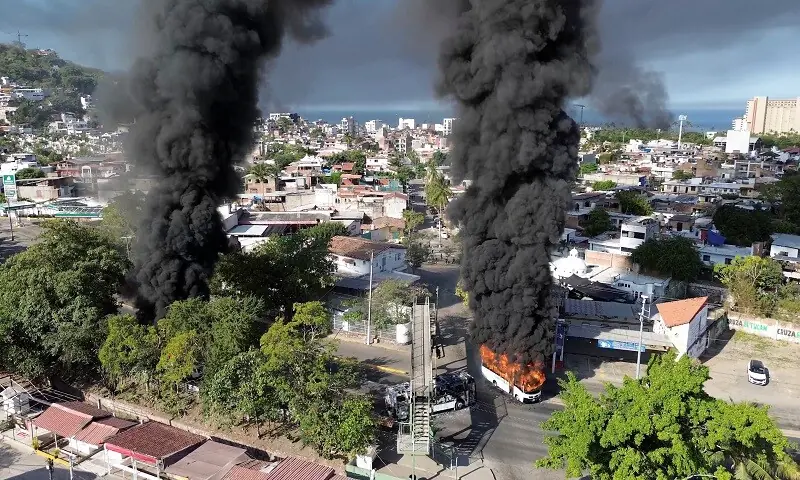
Within hours of the killing of Mexican drug lord Nemesio Oseguera, better known as El Mencho, in a military raid on Sunday, gunmen suspected to be his supporters blocked highways across several states and set cars and businesses ablaze.
In some towns, tourists and residents were urged to stay indoors, while truckers were advised to take safe routes or return to their depots until the violence abated.
Several airlines, including Air Canada, United Airlines and Aeromexico, on Sunday canceled flights to Puerto Vallarta, a beachside resort town where stunned tourists filmed plumes of smoke rising into the sky from fires.
The burst of violence across more than half a dozen states painted a familiar scene for Mexicans who have spent two decades watching successive governments wage war on drug cartels, ravaging broad swaths of the country.
A member of Oseguera’s Jalisco New Generation Cartel told Reuters that the blazes and sporadic gunfire were carried out in revenge for the government’s killing of Oseguera, and warned of further bloodshed as groups move to take control of his cartel.
“The attacks were carried out in revenge for the leader’s death, at first against the government and out of discontent,” the person said, speaking on condition of anonymity.
“But later, the internal killings are coming, by the groups moving in to take over.”
In Mexico’s Pacific coast, a five-hour drive from the military operation in the town of Tapalpa that took down the leader of the powerful Jalisco New Generation Cartel, stunned beachgoers on a pier in Puerto Vallarta took out their cell phones to film thick waves of smoke obscuring blue ocean views, showed a video shared with Reuters.
Daniel Drolet, a Canadian who has wintered in Puerto Vallarta for years, said in a phone interview that he was concerned about a new era of violence taking root in the typically placid resort zone.
“I have never seen anything like this before,” he said.
In the state of Jalisco, authorities reported that gunmen had attacked a base for the National Guard military police, and recommended guests remain inside hotels and suspended public transit.
Other scenes of criminal activity and military response were captured in videos shared by government security sources with Reuters: A green military tank made its way through a residential neighborhood in the state of Aguascalientes.
Roadblocks paralyzed the highly transited Mexico-Puebla highway. In the state of Colima, cartel members standing in pick-up trucks blocked a road.
A trucking industry group said in a statement it was “profoundly worried” by the highway violence and recommended that truckers keep to safe areas or return to their operating yards until conditions improve.
The state of Guanajuato, a CJNG stronghold, reported 55 incidents across 23 municipalities, with 18 arrests, but said by evening all incidents were under control.
Carlo Gutierrez, who lives in Guadalajara, Jalisco’s capital, said that friends on WhatsApp groups were encouraging people to stay home.
“There is fear and a lot of caution,” he said of the city, one of three main Mexican venues for World Cup soccer matches this summer.
Former cop turned kingpin
Oseguera, a former police officer, founded and oversaw the rapid rise of the CJNG, named for the western state of Jalisco that is home to one of Mexico’s biggest cities, Guadalajara.
In recent years, CJNG has expanded into one of Mexico’s most powerful cartels, known for violent tactics including forced labor and forced recruitment.
Under El Mencho’s leadership, CJNG also became a highly diversified criminal enterprise, expanding from drug trafficking to fuel theft, extortion, human smuggling, and complex financial frauds.
The cartel pioneered the use of drones in attacks against civilians in remote regions of western Mexico as part of its rapid territorial expansion.
Sunday’s raid was one of Mexico’s highest-profile blows against drug gangs responsible for smuggling billions of dollars of drugs – including fentanyl – into the US.
In recent years, the leaders of the rival Sinaloa Cartel – Joaquin ‘El Chapo’ Guzman and Ismael “El Mayo” Zambada – were captured alive. Both are now in US prisons.
President Donald Trump’s administration praised El Mencho’s killing, but the domestic violence it triggered highlighted the political balancing act Sheinbaum must strike as her government escalates its cartel offensive.
Security experts were watching whether the raid and death of the cartel boss will fracture CJNG leadership and trigger bloody infighting.
“There will definitely be skirmishes between the various factions, and these spasms of violence could last for years,” said Carlos Olivo, a former US Drug Enforcement Administration assistant special agent in charge and an expert in CJNG.
Violence in wake of cartel arrests, killings
Authorities have not reported any casualties beyond several cartel members and officials killed during the military operation.
Previous cartel arrests and killings have led to outbreaks of violence – whether by members avenging their fallen leader or rival gangs muscling in on their territory – prompting Mexican authorities to hesitate before launching major campaigns.
In 2019, Ovidio Guzman, a son of Sinaloa Cartel kingpin Joaquin “El Chapo” Guzman, was detained but quickly released, setting off widespread gun battles. His arrest in 2023 set off more violence.
The 2024 arrest of Sinaloa Cartel boss Ismael “El Mayo” Zambada triggered a bloody power struggle in the criminal group that continues unabated more than a year later.
“I’m watching the scenes of violence from Mexico with great sadness and concern,” said US Deputy Secretary of State Christopher Landau, who previously served as ambassador to Mexico, in a post on social media.
“It’s not surprising that the bad guys are responding with terror. But we must never lose our nerve.”
Mexico’s President Claudia Sheinbaum in a social media post acknowledged the violence, but struck a tone of calm.
“In most of the national territory activities are happening with absolute normalcy,” she said.
Killing wins US praise
Deputy Secretary of State Christopher Landau, previously ambassador to Mexico, said Oseguera’s killing was a “great development” for the US and Mexico, as well as the rest of Latin America.
In January after the US capture of Venezuelan President Nicolas Maduro, Trump said “the cartels are running Mexico,” and warned “we are going to start now hitting the country with regard to the cartels.”
Sheinbaum said she would strengthen efforts to cooperate with the US to fight cartels., but vowed to uphold Mexico’s sovereignty and warned against any unilateral military action by the US in Mexico.
Sheinbaum, in a social media post on Sunday, said security officials would provide information on the operation.
