

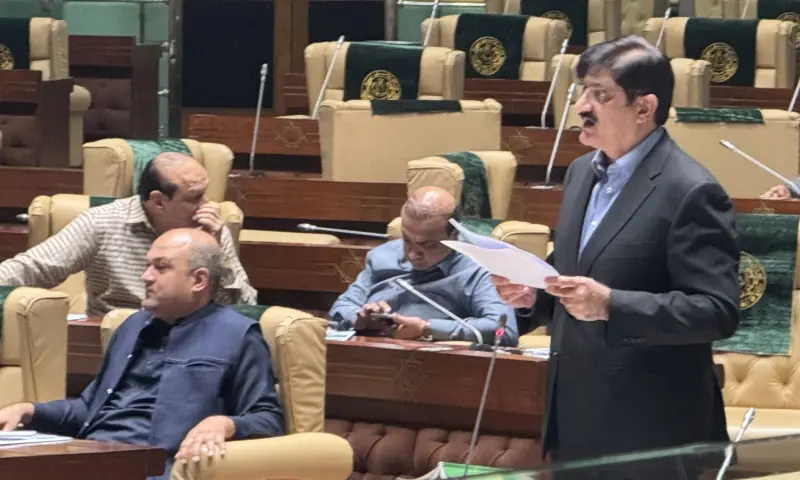
KARACHI: The Sindh Assembly on Saturday passed a resolution declaring Karachi an “inseparable part” of the province and opposing any move that suggested otherwise.
The resolution, tabled by CM Murad and passed with a majority, stated that the House “unequivocally condemns and rejects any conspiracy aimed at the division of Sindh or the creation of a separate province comprising Karachi”.
“Karachi is, and shall forever remain, an integral and inseparable part of Sindh,” it declared.
The chief minister’s move comes after the Muttahida Qaumi Movement-Pakistan (MQM-P) has repeatedly called for the Centre’s intervention in Karachi, demanding that the metropolis be made a “federal territory”.
The resolution urged “all political stakeholders to refrain from divisive rhetoric or actions that threaten provincial harmony and national cohesion”.
It reaffirmed that the “unity, territorial integrity, and historic identity of Sindh are sacred trusts inherited from our forefathers and shall be defended through constitutional, democratic, and political means”.
The resolution stated that the Sindh Assembly stood “united — beyond party lines — in defense of Sindh’s integrity, dignity, and unbroken legacy”.
Lone Jamaat-i-Islami (JI) MPA Muhammad Farooq, and PTI’s Shabbir Qureshi and Sajjad Soomro supported the resolution, while MQM-P leaders voted against it.
In their speeches, the MQM-P members contended that the resolution contradicted the Constitution.
The MQM-P and the PPP have been engaged in a war of words since the deadly Gul Plaza inferno, trading blame over improper governance during the tenure of their respective party mayors.
Earlier this week, MQM-P’s Mustafa Kamal — also the federal health minister — criticized the provincial administration for what he described as systemic neglect of Karachi’s residents.
Responding to the opposition’s debate regarding the resolution, CM Murad categorically rejected claims that the resolution was unconstitutional, challenging opponents to identify even a single point that violated the law.
He pointed out the “shifting” stance of the MQM-P, recalling that the House had passed a similar unanimous resolution against the division of Sindh in 2019, and at that time, MQM-P stood in support.
“The members of MQM cannot play on both sides of the fence,” he remarked.
On the opposition’s grievance regarding mentions of the governor, the chief minister clarified that the resolution itself did not mention the governor by name.
“If a member takes the governor’s name, you may expunge it from the proceedings; it has nothing to do with the resolution,” Murad stated. However, he noted that a meeting regarding such matters did indeed take place at the Governor’s House.
Rejecting the opposition’s claim that they “smell something fishy” behind the resolution, the Sindh CM retorted, “You say you smell something. [fishy]but I smell something from your conduct.”
Murad condemns ‘division’ rhetoric
Speaking on the floor of the assembly after tabling the resolution, CM Murad said no one could divide Karachi or separate it from Sindh.
“Karachi is an inseparable part of Sindh,” the chief minister added.
He affirmed that the Sindh Assembly would uphold provincial unity and solidarity, as well as protect the province.
Referring to opinions suggesting Karachi be made into a province separate from Sindh, CM Murad said: “I condemn all these statements.”
The chief minister contended that the “enemies” of Pakistan had launched a campaign to divide the country’s people. “Whoever believes in Pakistan will support this resolution,” he said.
The chief minister noted that it was for the two-thirds majority of the Sindh Assembly to decide if any move to create a new province was attempted.
He also invoked the slogan “Pakistan Khappay”, raised by Asif Ali Zardari, emphasizing that the PPP stands for national unity and federalism.
“PPP will never go against Pakistan’s integrity. It is you who speak of dividing Pakistan,” he said in a pointed rebuttal to critics.
He recalled that a similar resolution had been passed by the Sindh Assembly in 1994, emphasizing that this was “not the first time” the province had resisted attempts to undermine its unity.
He pointed out that when Karachi was declared the capital in 1948, the country did not yet have a constitution, arguing that constitutional clarity today leaves no room for “unilateral” decisions.
Without naming any political party, Murad said the resolution targeted no individual but urged members to read it carefully and raise objections, if any, through democratic debate.
“Opposing this resolution would amount to supporting the division of Sindh,” he remarked.
Concluding his speech, CM Murad declared: “Even the thought, dream or idea of breaking Sindh will never succeed.”
‘Sindh has collectively contributed to building Karachi’
The resolution detailed Sindh’s history as a province, including it being the first province to “pass the resolution in favor of Pakistan, reflecting its longstanding commitment to federalism, democracy, and national unity”.
It highlighted that the framers of the 1973 Constitution “reaffirmed the federal structure of the country and explicitly provided under Article 239 that no alteration of provincial boundaries shall take place without the consent of more than two-thirds members of the concerned provincial assembly”.
“The sons and daughters of Sindh — from Karachi to Ketibundar, from Kashmore to Karoonjhar — have collectively contributed to building Karachi into the economic engine of Pakistan, symbolizing unity in diversity rather than division,” the resolution noted.
It pointed out: “Karachi, historically known as Kolachi, emerged from the soil of Sindh and evolved as its principal port, commercial heart, and gateway to the world — nurtured by the land, labor, and collective spirit of the people of Sindh — and despite serving as the first capital of Pakistan after independence in 1947, remained geographically, historically, and emotionally inseparable from Sindh.”
The resolution cautioned, “Any attempt to divide Sindh, fragment its territory, or detach Karachi from Sindh is contrary to history, constitutional spirit, democratic norms and the deeply held sentiments of the people of Sindh, and would undermine national cohesion and the federal compact.”
It recalled that the people of Sindh resisted the imposition of the One Unit scheme in 1955, which dissolved historic provinces into an artificial administrative structure, and that the “restoration of Sindh in 1970 stands as enduring testimony to the unwavering resolve of its people to safeguard their province”.
Noting that Sindh was one of the world’s oldest living civilizations, the resolution highlighted that it was a province “whose identity, language, and cultural continuity predate modern political boundaries and have endured invasions, empires, and colonial rule”.
