

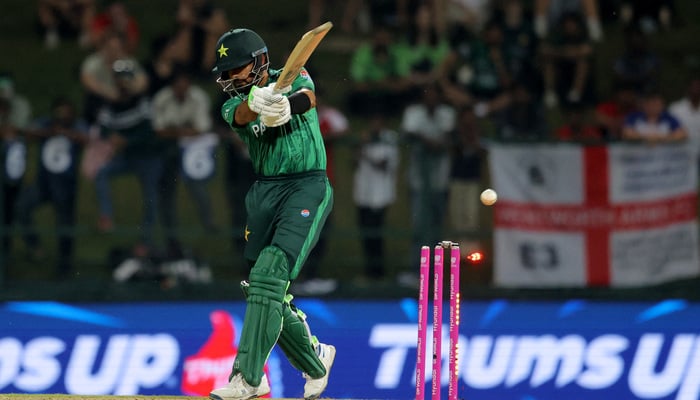
Widely regarded as Pakistan’s star batter, Babar Azam’s struggles in the ongoing ICC Men’s T20 World Cup have once again sparked debate about his effectiveness in the shortest format, with former cricketers pointing to concerns over his strike rate, tempo and ability to adapt.
Pakistan lost to two-time champions England in the high-stakes Super Eights match of the ICC Men’s T20 World Cup 2026 at the Pallekele International Cricket Stadium on Tuesday.
Babar scored just 25 runs off 24 balls at a strike rate of 104 before being bowled by Jamie Overton.
Speaking on Geo News’ show “Harna Mana Hai”, former Pakistan cricketer Rashid Latif said bluntly that Babar is “no longer a player of this format”, questioning why he was brought back after being dropped over strike-rate concerns six months ago.
Latif recalled that team management had earlier stated Babar would return once his scoring rate improved. “Where did it improve? Why did you bring him back?” he asked, calling the decision an injustice by the board and coaching staff.
He also criticised Pakistan’s batting tempo, saying modern T20 cricket demands players who can shift gears and control the chase. According to him, when a batter consumes 20–25 balls without accelerating, pressure builds on the other end and forces incoming players into risky shots. He added that set batters must take responsibility and bat deep when partners struggle to score.
Host Tabish Hashmi remarked that the team had discussed a plan three years ago on how to dismiss Babar, yet he continues to fall in a similar fashion, raising questions about whether the fault lies with the player, coaching staff or the system.
Latif compared Pakistan’s approach with opposing batters who keep scoreboards moving under pressure, noting that successful players “play from both ends” and maintain control of the chase. He suggested Pakistan’s batters often fail to shift gears when acceleration is required, allowing pressure to mount.
Cricketer Ahmed Shehzad highlighted decision-making during the innings, saying there were moments when quick singles or doubles could have relieved pressure but were not taken. He also questioned why a player with more than a decade of experience still struggles to read quality leg-spin.
Referring to an incident against England’s Adil Rashid in Tuesday’s match, Shehzad said Babar nearly lost his wicket to a googly.
“Is this improvement?” He argued that unless players accept their weaknesses and adapt to modern T20 demands, particularly power-hitting and risk-taking, improvement cannot happen, calling the lack of acceptance Babar’s “biggest downfall.”
Fast bowler Mohammad Amir agreed with the assessment, confirming that Babar failed to pick the variation properly.
The panel also discussed how delays in acceleration can affect partners at the crease, noting that when one batter slows the scoring rate, the incoming players feel compelled to attack immediately and often lose their wickets in the process.
The discussion reflected growing scrutiny over Babar’s role in Pakistan’s T20 setup, as critics urge greater adaptability, smarter strike rotation and stronger intent to match the evolving demands of modern T20 cricket.
