
I came across this quote somewhere, although I can’t remember the exact source. Music writer Simon Frith, maybe? Anyway, it goes like this: “Every generation has a biological right to believe that the music of their youth is the best music of all time.”

We all have our coming-of-age years when it comes to music, which run about a decade. It starts around age 13 or 14 and runs out by the time we’re in our mid-20s. During that time, music is as vital to our being as breathing. We’re newbies, which means there’s so much to discover. Music will never be this exciting again.
There’s a psychological component to this, too. As our hormone-flooded brains develop, we use music to figure out our feelings and emotions. Music helps us understand who we are as human beings. And once certain realizations start to coalesce, we then use the music we love to tell the world who we are. We project our identities through music, with some of us adopting the appearance and costumes of a specific tribe: punk, goth, metal and so on. And for about ten years, we’re sponges. We can’t get enough music into our lives.
But then, by ages 23 or 24, life starts getting in the way. Jobs, relationships, children, obligations and other non-musical pursuits occupy more of our time. While we remain music fans, it slips down the rankings of life’s priorities. We devote less of our energy to music discovery, going to gigs, browsing online and buying t-shirts. It’s not like we abandon music — far from it — but things will likely never be as intense as they were during those coming-of-age years. However, the music of your youth will remain your comfort food for the rest of your life. When you’re stressed, melancholic, nostalgic or just need a pick-me-up, there’s nothing like going back to what you were listening to during high school and college. You will forever believe that this is the best music ever made.

Get breaking National news
Get breaking Canada news delivered to your inbox as it happens so you won’t miss a trending story.
This sets up a generational battle. Whose youth had the best music? Which was the best decade for music? Stat Significant found this YouGov survey of U.S. adults taken in June 2021, which more-or-less tracks what I just said.
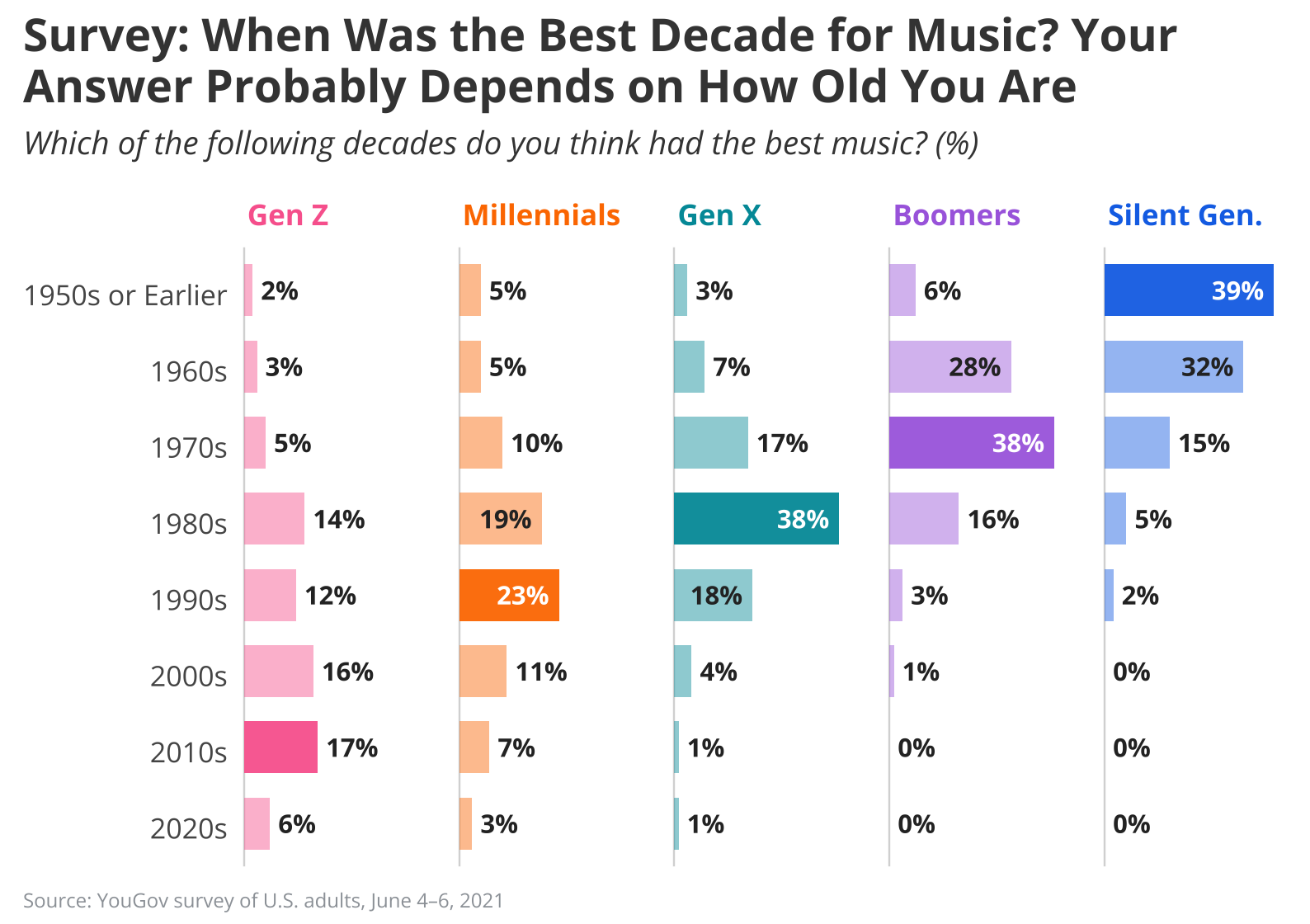
But during my interactions with those who have come out to my current national speaking tour, I’ve noticed something interesting with younger attendees. Many of them, especially late millennials and all manner of Gen Zers, are ignoring the contemporary music, that is, the music of their youth. Anecdotally, they appear to be much more engaged with music that came out years, sometimes decades, before they were born.
An example: I spoke to a young man of about 15. “Who is your favourite band?” I asked. He shuffled a little nervously. “They’re pretty weird. I doubt that you’ve heard of them.”
When I pressed him, he sighed. “They’re called The Cure,” he said.
Intrigued by this encounter, I began asking adults in the audience what their kids were listening to. The vast majority said, “Oh, they’re all about the 90s. They’re into the same alt-rock I grew up with.” A few also said their kids were crazy about the 80s, while others proudly declared their offspring was living on a steady diet of Led Zeppelin, Iron Maiden and Black Sabbath.
This would be the equivalent of 15-year-old me pining for the era of Frank Sinatra and even some big bands. If you were a Gen Xer who remembers when Nirvana’s Nevermind came out, the equivalent would an infatuation with pre-Beatles rock. What’s going on?
Several things, I think. First of all, the relationship between parents and their children is different from when I was growing up. Many of today’s moms and dads want to make sure their kids grow up with “good” music and are willing to share their collections and playlists with their sprog. Sharing this music is ultra-simple, too, thanks to streaming. Yes, the kids might go through dad’s CD and vinyl collections, but it’s so much easier to instantly call up something on Spotify.
This has gone a long way to eliminating biases about era and genre. The musical generation gap that used to exist between parents and their children has largely collapsed. Little Britany is just as likely to listen to Van Halen as mom is to listen to Taylor Swift.
Audio quality plays a factor. Around 1969, recording studio technology had evolved to around where it is today. A song recorded in 1971 has the same sonic quality as something recorded yesterday. Style aside, it doesn’t sound old, like something played off a dusty 78 RPM record. Remastered reissues and high-res recordings are turning 60-year-old songs into modern audio masterpieces.
Finally, maybe it’s because today’s music — and I’m speaking generally here — just isn’t as good as the music from the 70s, 80s, 90s and early 2000s. Yes, there are plenty of excellent songs and albums coming every week, but it’s possible that people are being distracted by the dreck.
We’ve been living in the modern era of popular music for close to 70 years. In that time, music has evolved, segmented and ridden off in all directions at once. Many of the early acts got to the best ideas — melodies, riffs, chord progressions — first. With a few exceptions, much of today’s music consists of derivative rediscoveries of well-worn ground. And don’t get me started on how over-produced and inhumanely perfect today’s pop music can be.
It used to be that “music of our youth” meant the contemporary music of our coming-of-age years. It now means any music we discover when we’re young.
I’d love to see a new version of that YouGov poll today.
© 2026 Global News, a division of Corus Entertainment Inc.