
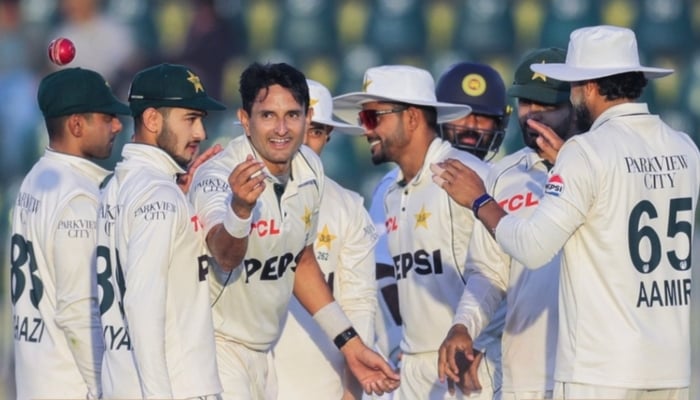
KARACHI: Pakistan’s recent Test series victory over Sri Lanka has offered some much-needed encouragement for a team struggling to rediscover its consistency in red-ball cricket. But against this backdrop, lies a rather alarming statistic that deserves as much attention as the performances on the field.
Pakistan surrendered 24 World Test Championship points through slow over-rate penalties during the ongoing 2025–27 cycle. To put that into perspective, those deductions are equivalent to the points awarded for winning two Test matches.
For a team that has managed just three victories in 11 Tests during the current championship, losing the equivalent of two wins through disciplinary violations is an extraordinary and entirely avoidable setback.
What makes the situation particularly concerning is that these penalties have not resulted from one unusually slow day in the field. They have accumulated across three separate series, against different opponents and in different conditions.
Pakistan were first docked eight points against Bangladesh in Mirpur in May 2026, followed by another 11 against England at Edgbaston in September. The latest five-point deduction came during the opening Test against Sri Lanka in Rawalpindi earlier this month.
Three matches, three substantial penalties, and 24 championship points lost.
The consequences are clearly reflected in the WTC standings.
Pakistan currently occupy ninth position in the nine-team competition, with 16 points and a points percentage (PCT) of 12.12. They have won three matches, lost seven and drawn one.
Without the over-rate deductions, Pakistan would have accumulated 40 points and their PCT would have stood at 30.30, enough to place them seventh, ahead of the West Indies and Sri Lanka.
In other words, Pakistan would not have been sitting at the bottom of the World Test Championship table.
Of course, that hypothetical position would hardly have transformed Pakistan into championship contenders. Even without the penalties, their results have been nowhere near good enough to challenge the leading teams.
But that is not really the point.
A problem bigger than the current WTC cycle
The more significant concern is not necessarily what these deductions have cost Pakistan in the ongoing championship, but what the same pattern could cost them in the future.
Pakistan are already effectively out of contention for a place in the 2027 WTC final. Whether they finish seventh, eighth or ninth is unlikely to change the broader assessment of another disappointing championship campaign.
However, imagine a different scenario in the next cycle.
Suppose Pakistan begin winning consistently, improve their performances overseas and find themselves competing for one of the two places in the WTC final. In such circumstances, even a deduction of four or five points could make the difference between qualification and elimination.
Losing 24 points in a competitive campaign could be catastrophic.
And that is precisely why the problem needs to be addressed now, rather than waiting until the consequences become irreversible.
The World Test Championship is structured around the percentage of available points earned, making every point significant. Teams cannot afford to treat over-rate penalties as routine disciplinary matters, particularly when qualification margins can be narrow.
Why has slow over-rate become a recurring problem?
Perhaps the most puzzling aspect of Pakistan’s repeated violations is the apparent inability of the team management to find a lasting solution.
One slow over-rate offence can be explained by unusual match circumstances. Even a second violation might be attributed to a combination of tactical decisions, interruptions and difficulties in managing the pace of play.
But three substantial penalties across different series should prompt a serious examination of how Pakistan manage their time on the field.
Are bowlers taking too long between deliveries? Are field placements consuming excessive time? Are tactical discussions unnecessarily delaying proceedings? Is the captain receiving adequate assistance from the coaching and support staff in monitoring the over-rate?
These are questions that demand answers.
Modern international teams operate with extensive support structures, including analysts, performance specialists and experienced coaches. Monitoring the over-rate should hardly be beyond their capabilities.
While responsibility for maintaining the required rate primarily rests with the captain and players on the field, the coaching staff and management cannot be entirely detached from a problem that continues to recur.
That situation should concern the Pakistan Cricket Board as much as the team’s batting and bowling performances.
A batting collapse triggers questions about technique and temperament. A bowling failure leads to debates about selection and strategy. Captains are criticised for their decisions, while coaches are asked to explain disappointing performances.
Yet slow over-rate violations rarely generate comparable scrutiny, even when their impact on championship standings can be substantial.
This cannot be ignored any more.
Pakistan have spent considerable time and effort trying to win Test matches, but have simultaneously surrendered the points from two victories through failures in over-rate management.
Unlike the challenge of facing a world-class bowling attack or defending a modest total, maintaining the required over-rate is largely an operational and tactical responsibility that teams can plan for and improve.
There will inevitably be circumstances beyond a team’s control, and the ICC’s regulations account for permitted delays. Nevertheless, repeated violations point towards a weakness that requires attention.
The issue is not simply about imposing blame on the captain or singling out individual bowlers. It is about establishing a system in which the team understands the importance of every championship point and takes practical steps to protect them.
There is a warning hidden behind this statistic.
Building, or rebuilding, a competitive Test side requires more than finding talented players. It also requires discipline, consistency, tactical awareness and attention to detail that can influence results and championship standings.
Pakistan’s slow over-rate problem is one such detail, and the scale of the penalties suggests it can no longer be dismissed as a minor administrative issue.
Across the current WTC cycle, four teams have collectively lost 55 points through slow over-rates. Pakistan account for 24 of those points, followed by Sri Lanka with 15, England with 14 and the West Indies with two.
Pakistan’s deductions are the highest among the nine competing teams, an unwelcome distinction for a side already struggling to improve its standing in Test cricket.
This particular weakness does not require the discovery of a new fast bowler, the development of a technically superior batter or a complete overhaul of the domestic structure. It requires better planning, clearer responsibility and more effective management of playing time.
Pakistan may not pay a decisive price for these 24 lost points in the current championship because their chances of reaching the final are already remote.
But if the team succeeds in rebuilding its Test cricket credentials, the same indiscipline could become far more damaging in the next cycle.
Imagine Pakistan missing a World Test Championship final by a handful of percentage points, only to discover that the difference came from overs they failed to complete on time.
That would be considerably harder to accept than losing to a better team on the field.