
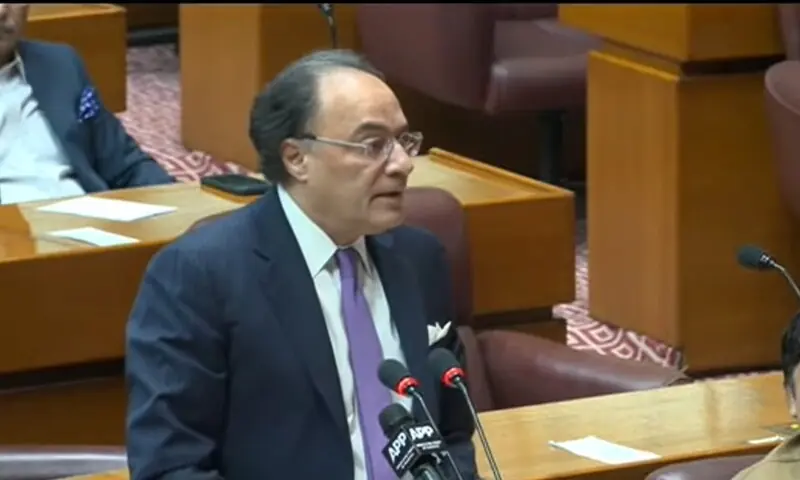
Finance Minister Muhammad Aurangzeb on Saturday asserted that the proposed budget for the next fiscal year (FY27) would set the foundation for “accelerating the sustainable growth” recorded in the past two years.
He made the remarks on the floor of the National Assembly as he wound up the debate on the budget FY27, which was presented on June 12.
The finance czar recalled that MNAs presented their opinions on the proposed budget during the debate, adding that reservations were also voiced in some proposals.
“But, we have gotten very clear feedback from inside and outside the House that this is overall a positive and pro-growth budget, which sets the foundation to accelerate the sustainable growth witnessed over the last two years,” he declared.
Speaking on the budget proposals, Aurangzeb stated that a “sustainable and inclusive export-led growth that increases productivity” was the fundamental objective of the government and the budget.
“We often hear and see that the documented corporate sector and salaried class have to bear most of the tax burden. The government has changed this trend and thinking in the budget, and focused on deepening and broadening rather than burdening,” he contended.
“We had initiated this change in the last budget and clarified our direction. In this budget, we have taken additional and concrete initiatives regarding it,” the finance czar affirmed.
He added that the burden of existing taxpayers — particularly the salaried class, small businesses, exporters and industrialists — would be reduced under the FY27 budget, keeping in mind the “principles of equity and fairness”.
“We have ensured the provision of concessional loans for importers and the agriculture sector,” Aurangzeb said, emphasizing that the Fixed Asaan Tax Scheme has been introduced to broaden the tax net.
Elaborating on reforms brought in the tax sector in the past two years, he said: “We have detached tax policy from tax administration. We are introducing a new tax operating model in continuation of these reforms, under which the interaction between a taxpayer and a tax officer will be removed.
“The process of audit, identification and implementation will be conducted through an automatic […] system,” the minister said, adding that these reforms aimed to end discretionary powers and prevent harassment through digitization and promote transparency.
Responding to remarks made by some lawmakers on the Federal Board of Revenue’s (FBR) performance, Aurangzeb said that the government welcomed constructive criticism but stressed the need to consider the context.
Presenting a “comparative analysis”, the minister noted that an additional $14bn was collected in revenue from 1988 to 2011.
“Similarly, additional revenues of $14bn were collected in the next 13 years from 2011 to 2024. Compared to this, in the brief period of the past two years, our government has secured additional revenues of $14bn,” he stated.
On the discussions held about the agricultural sector during the budget debate, Aurangzeb affirmed that the sector was the “backbone” of Pakistan’s economy and the government had announced “satisfactory relief and developmental packages” for farmers.
He noted that the Zarkhez scheme had been initiated, under which interest-free and collateral-free loans were being provided to 750,000 small-scale farmers.
He further said that Rs9.5bn have been allocated in the FY27 budget for subsidies in the Prime Minister’s Youth Business & Agriculture Loan Scheme (PMYB&ALS), under which loans worth more than Rs109bn will be given.
To keep fertilizer prices within control, a package of Rs15.8bn has been announced in the budget, which includes a Rs10bn subsidy on urea fertiliser, according to the minister.
The finmin went on to mention the Rs4.2bn earmarked for development programs in the agriculture and livestock sectors. He added that an import duty relief worth Rs2bn was being given to abolish duties on tractors, combined harvesters and other equipment to modernize agriculture.
“I specifically want to mention that we are expanding agricultural cooperation with China,” Aurangzeb said, noting that Pakistani students and experts were being trained on the subject.
“We are going to construct an agricultural cold storage in collaboration with the private sector, which will cost Rs7.1bn, because investing in this value-chain is extremely important to get the value-added agriculture moving,” he stressed.
The finance czar highlighted that in the budget, the government has given tax relief to the salaried class, increased the pay and pensions of government employees, introduced measures to facilitate the process of obtaining pensions, Abolished taxes on sanitary pads and contraceptives, and reduced taxes on life-saving medicines.
The minister said that the NA had saved Rs5bn by taking austerity measures, while the Senate saved Rs1bn.
Aurangzeb thanked the lawmakers for participating in the budget debate, specifically Opposition Leader Mehmood Khan Achakzai, as well as Saleem Mandviwala and Naveed Qamar, who head the standing committees on finance for the Senate and NA, respectively.
The minister said both committees reviewed the budget recommendations with sincerity and gave their recommendations for improvement, “some of which are intended to be included in the Finance Bill 2026”.
He also thanked the leaders of the parties in the ruling coalition by name, describing their leadership as “very important in preparing the budget”.
Concluding his speech, Aurangzeb stressed that “national consensus was extremely important in the economic and financial recovery”. He requested all stakeholders to continue their cooperation for the country’s economic development.
‘No changes made to methodology for economic indicators’
The minister recalled that the government had stated its “direction of travel” in the previous budget, adding that progress has been made over the past year on “many fronts” and economic indicators have been improved.
The finmin pointed out that the 6.6pc growth in the large-scale manufacturing sector was the highest level in the past four years.
“Our external account is also stable,” he said, adding that the current account recorded a surplus in the first 11 months of the current fiscal year (11MFY26).
Aurangzeb also mentioned the record $4.25 billion remittances received in May, expressing hope that the country would meet its target of $41bn remittances in FY26.
“The exports sector is showing improvements. There is a prominent increase in the value-added exports, especially garments, home textiles and IT sectors,” he said, recalling that IT exports had witnessed a 20 percent increase in the outgoing year.
“Our youth freelancers have also made a new record of exports earnings and have secured record earnings of $1.6bn so far,” he said.
At the outset of his speech, Aurangzeb noted that a privilege motion had been moved by Khawaja Sheraz Mehmood and Azimuddin Zahid, which contended that the budget document had discrepancies.
He added that questions were raised on the GDP growth for FY26, the per capita income and their methodology.
“I want to clarify that no changes at all have been made to the methodology used for reporting the economic indicators,” the finance czar said.
He remarked that the economic indicators for FY18 would also be presented before the MNAs who raised the concerns, so that “it is apparent that there is consistency of measurement from administration to administration”.
The minister explained that the real GDP growth was calculated after adjusting for changes in economic activities and their impact on prices.
“This is why the 3.7pc GDP growth reported by PBS (Pakistan Bureau of Statistics) has been calculated on the constant prices of base year FY15-26,” he said, adding that it was an international standard from a methodology perspective.
The finance czar then elaborated that the nominal GDP, which is calculated on current market prices, differed from the real GDP in “both concept and measurement”.
“As per international practices, the per capita income is also determined based on current prices and is calculated on the gross national income (GNI) and estimated population,” he said, noting that the population estimates from 2023 and predictions were used.
Auranzgeb noted that GNI is a sum of the nominal GDP and net factor income received from abroad, and includes workers’ remittances.
He stated that the size of the economy (nominal GDP) rose from $408.2bn in FY25 to $452.1bn in FY26.
During his speech, the finance minister highlighted Pakistan’s role as mediator between the United States and Iran, which led to the peace memorandum signed this week.
Terming it a “golden chapter” of Pakistan’s diplomatic and political history, he praised the national leadership and congratulated the parliament.
“The first dividend of this peace agreement has already been announced by the prime minister in terms of the significant reduction in the petroleum prices,” he said, referring to the Rs74 reduction in petrol price and Rs67 cut in diesel rate.
NA debates Senate recommendations
Earlier in the day, the NA debated the 140 recommendations made by the Senate on the budget.
The Senate was given the responsibility to submit budget recommendations under the 18th Amendment in 2010. Under the Constitution, the Senate has no power to vote on a money bill; this power exclusively lies with the NA, which is the directly elected House.
As lawmakers debated over the recommendations, some even contradicted their own positions of the past.
PTI leader Asad Qaiser and other lawmakers from Khyber Pakhtunkhwa demanded higher taxes on cigarettes but not on the tobacco crop, which they said should be considered as an agricultural product.
PTI-backed Muhammad Atif criticized sales tax relief for Pakistan International Airlines, arguing that it should be across the board for all.
He questioned why there was relief proposed for business and first class passengers only, but not for those traveling in economy.
PTI’s Amir Dogar demanded that the finance minister explain the Pakistan Telecommunication (Re-organisation) (Amendment) Act 2026which he termed “draconian”.
Notably, when the bill was approved by the NA on June 11 by a majority vote, there was no objection even by the PTI members at that time.
On Tuesday, the Senate Standing Committee on IT Extensively deliberated the bill, which seeks to amend the Pakistan Telecommunication (Re-organisation) Act of 1996.