

Solana Foundation is moving to back teams building fully onchain perpetual futures, setting up a clear challenge to the market structure that has powered Hyperliquid’s rapid rise. The initiative targets one of crypto’s most lucrative trading segments: perps, where volume still sits largely on centralized exchanges or hybrid venues.
Solana Vs. Hyperliquid
The Foundation framed the push as a bid to move derivatives execution more fully onto Solana, without relying on the offchain components that still underpin much of the sector. “Perpetuals are one of the most important financial primitives in crypto,” the Foundation wrote on X. “Solana makes it viable to run them fully onchain, without sacrificing the performance real participants and institutions require.”
Perpetuals are one of the most important financial primitives in crypto.
Solana makes it viable to run them fully on-chain, without sacrificing the performance real participants and institutions require.
We want to support teams building onchain 👇 pic.twitter.com/7m50BzoZZ3
— Solana Foundation (@SolanaFndn) June 1, 2026
The timing is remarkable. Hyperliquid has become the reference point for onchain derivatives, turning perpetual futures into one of the strongest product-market-fit stories in crypto. While Solana did not name Hyperliquid in its announcement, the competitive subtext is hard to miss.
In its post, the Foundation argued that most perp volume still flows through centralized exchanges or through hybrid architectures that use off-chain sequencers and matching engines. “We see that as a transitional state, not a permanent one,” the Foundation said. “We want to support teams building onchain perps, other derivatives, and the applications around them, that prioritize price discovery infrastructure. Our support takes several forms: distribution, technical assistance, and above all, capital.”
That language matters because it draws a line between merely settling crypto trades onchain and running the entire execution path onchain. The foundation said it wants to support systems where every order submission, oracle update, match, cancellation and settlement happens on-chain. For a chain that has long marketed itself around high throughput and low latency, perps are an obvious stress test: the product requires fast updates, deep liquidity, competitive market making and credible settlement.
The Foundation also made it clear that it is not looking for pool-based pricing models as the center of this effort. It said it is interested in “models where price is set based on two-sided flow, not pool-based or as a function of deposits,” including order books, RFQ systems with genuinely competing makers, or alternative designs where active participants set bids and offers against each other.
That is where the Hyperliquid comparison becomes especially relevant. Hyperliquid’s success has shown that crypto traders will use onchain or semi-onchain derivatives venues when the trading experience is fast, liquid and expressive enough.
Solana Wants Revenue Back Onchain
The announcement also included a more ecosystem-specific requirement: teams should build “Solana-first.” The Foundation said it wants projects optimized for SOL’s design and culture, with application revenue structurally routed back to the chain, preferably at the protocol level from launch rather than left to future governance decisions.
That is a pointed detail. In the current perps market, the battle is not only over where traders execute, but where fees, order flow and liquidity incentives accrue. A successful Solana-native perps venue would not merely add another DeFi app; it could become a recurring source of transaction activity, MEV-adjacent flow, validator economics and ecosystem-level liquidity.
The Foundation also said it is open to teams that have already built offchain or hybrid perps products and want to migrate to a fully onchain model. “We’ll support existing teams with a live product that are willing to explore a fully onchain, on-Solana model,” it said.
Open source is another filter. “Onchain integrity means little if the code behind it can’t be inspected,” Solana Foundation wrote. “Contributing to Solana culturally means contributing in the open.”
The initiative is not limited to core perps protocols. Solana said it also wants complementary infrastructure, including frontend integrations, vaults, structured products, aggregators, advanced trading interfaces, market making operations and social trading applications. Grants may be available through Solana Foundation funding channels or local Superteam chapters.
At press time, SOL traded at $79.54.
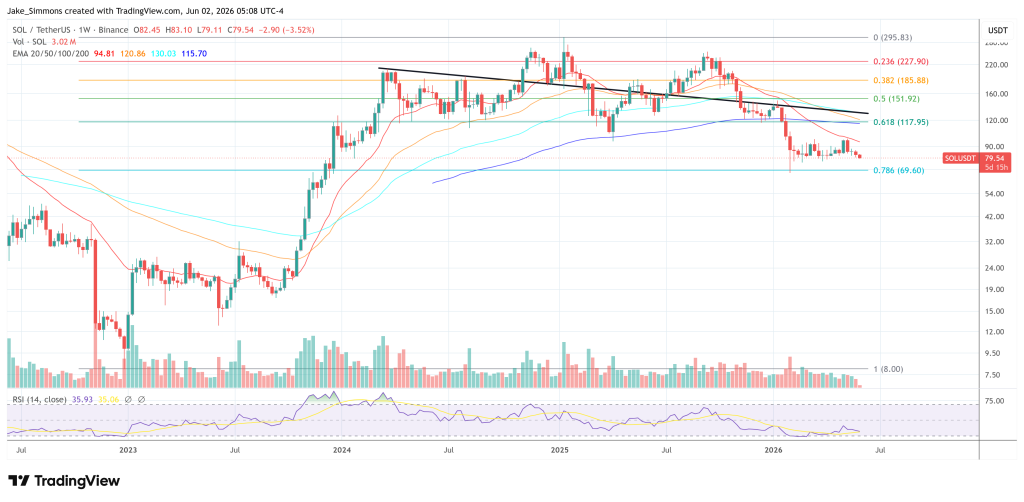
Featured image created with DALL.E, chart from TradingView.com
Editorial Process for bitcoinist is centered on delivering thoroughly researched, accurate, and unbiased content. We uphold strict sourcing standards, and each page undergoes diligent review by our team of top technology experts and seasoned editors. This process ensures the integrity, relevance, and value of our content for our readers.

