Over the past 24 hours, US and Israeli operations have focused on degrading Iran’s war-sustaining capacity through coordinated strikes on its three largest steel production facilities.
On the 29th day of the US-Israel war on Iran, the conflict transitioned into a more visibly regional phase as strikes on Iran’s industrial and nuclear infrastructure were met with coordinated retaliation across multiple Gulf states.
Over the past 24 hours, US and Israeli operations focused on degrading Iran’s war-sustaining capacity through coordinated strikes on its three largest steel production facilities, including plants in Ahvaz and Isfahan, effectively halting output at sites considered critical for missile and drone manufacturing chains.
Parallel attacks targeted nuclear infrastructure, including the Arak heavy-water plant and the Ardakan yellowcake facility, as part of exerting pressure on Iran’s strategic programs without directly crossing into overt nuclear escalation. Civilian impact also became increasingly more visible, with reports of casualties in residential areas of Isfahan and heavy munitions used in parts of Tehran and Qom.
Iran’s response exhibited a significant broadening of its targeting pattern, shifting more decisively towards Gulf assets linked to US and allied operations. Strikes were reported on Kuwait’s Bubiyan Island and Shuwaikh Port, where Iranian claims suggested damage to US logistical vessels, while in Saudi Arabia, a major ballistic and drone attack on Prince Sultan Air Base caused confirmed damage to high-value US assets, including aerial refueling aircraft and an airborne early warning platform, with American personnel also reported wounded.
In Bahrain, missile and drone strikes hit industrial facilities and a key refinery complex, alongside targeting of a US naval installation.
The conflict’s multifront character continued to intensify through proxy activity. Hezbollah maintained ground engagements and ambush operations in southern Lebanon, while Yemen’s Houthi movement formally entered the conflict space with its first ballistic missile launch towards Israel, a move that, while limited in scale, carried broader signaling value about the potential activation of additional fronts.
In Iraq and Jordan, Iran-aligned groups conducted strikes on air bases, further complicating the regional security picture and stretching defensive resources across a wider geography.
In Bahrain, the domestic situation became increasingly volatile during the past 24 hours following the death in custody of political prisoner Muhammad al-Mousawi, which triggered a wave of protests and renewed confrontation between Shia opposition and security forces. Protests have been reported across multiple towns and cities. It is feared that sustained unrest could complicate Bahrain’s ability to manage both internal dissent and its role within the broader regional coalition.
In southern Lebanon, fighting has continued at a steady and increasingly attritional pace, with Hezbollah maintaining effective ground resistance while continuing rocket and drone attacks into northern Israel.
The group’s operations have centered on coordinated ambushes along multiple border villages and towns targeting Israeli armor and supply routes. Hezbollah’s resilient fight has slowed advances and imposed material and psychological costs on Israeli forces. Failed Israeli efforts to secure key points, including towns along the Litani axis, has tied down its forces and reinforced the northern front as a persistent pressure point within the wider conflict.
Economic and strategic pressures are now becoming more deeply intertwined with military developments. Shipping through the Strait of Hormuz remained severely disrupted, while attacks on ports and industrial infrastructure in Kuwait and Bahrain underscored the vulnerability of regional supply chains.
At the same time, Iran looked to be reinforcing its narrative of proportionate retaliation while simultaneously signaling potential reconsideration of its international nuclear commitments, which has added to uncertainty in the strategic outlook.
Diplomatically, efforts continued but remained overshadowed by events on the ground. Qatar, Oman and Kuwait are reportedly pushing quietly for a ceasefire, even as Saudi Arabia, the United Arab Emirates and Bahrain have been signaling readiness to absorb further escalation. Washington, meanwhile, has indicated that operations could continue for several weeks. US President Donald Trump’s pause on energy infrastructure strikes appeared to be notional in scope because of the targeting of Iranian energy and industrial capacity.
The overall trajectory at the end of Day 29 suggests that the conflict was increasingly drawing in the wider region through both deliberate targeting and proxy activation.
While US and Israeli strikes were aimed at degrading elements of Iran’s industrial and strategic base, Tehran has, meanwhile, demonstrated an ability to extend the battlefield geographically and impose costs on multiple fronts. The risk of further horizontal escalation, going forward, remains high, and the coming days are likely to test the resilience of both regional states and the broader international system tied to Gulf stability.
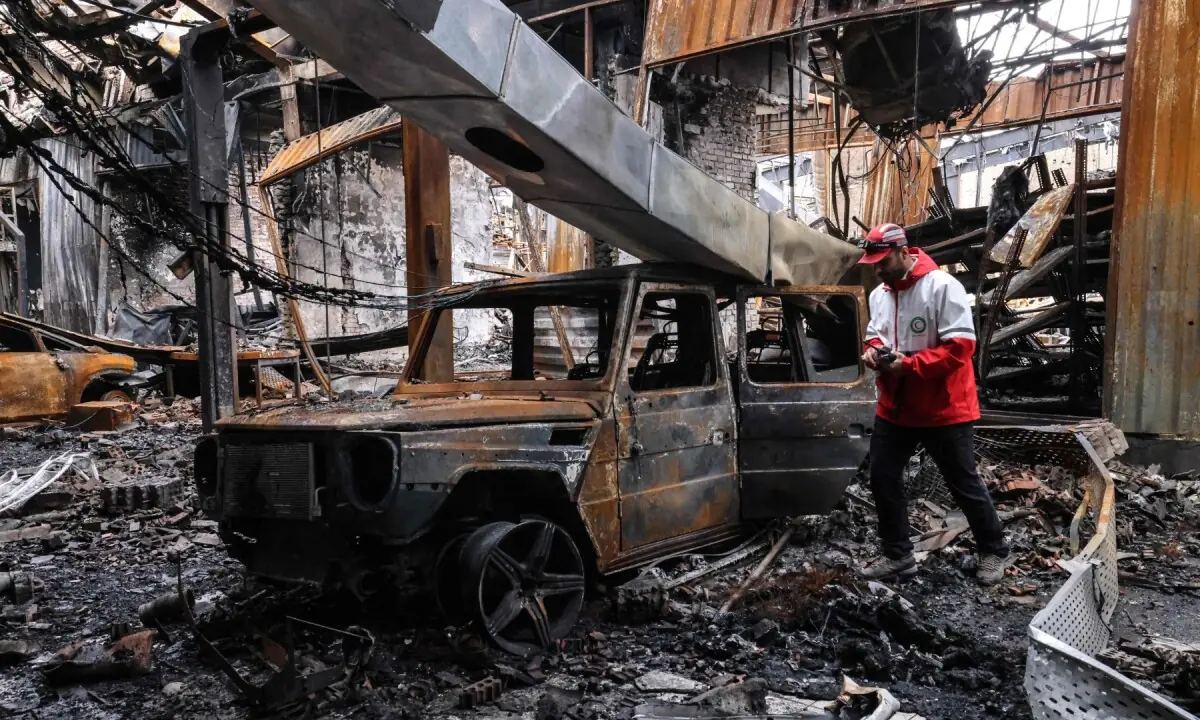
Header image: A member of the Iranian Red Crescent walks past the wreckage of a vehicle at a car service center in eastern Tehran, Iran, which was hit by a missile strike on March 28. — AFP