

The artificial intelligence arms race has entered a new, deeply personal phase. With its recent rollout of “Personal Intelligence,” Google is moving beyond generic chatbots to create a truly context-aware digital assistant. This isn’t just another feature update; it’s a fundamental shift in how we interact with technology, one that poses an existential threat to Microsoft’s long-standing dominance in productivity software and redefines the competitive landscape among top-tier AI models.
The “Personal Intelligence” Revolution Explained
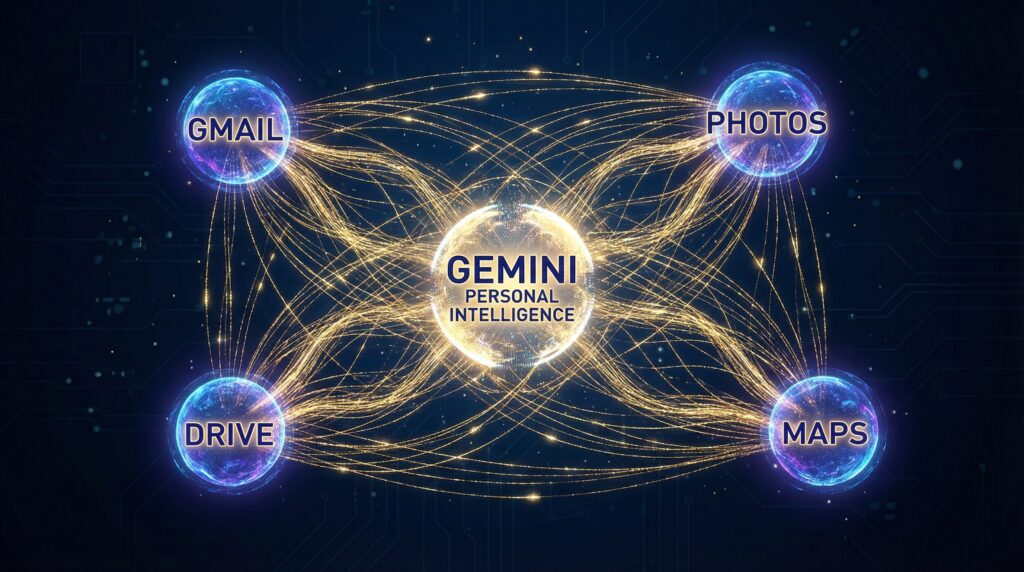
Google’s “Personal Intelligence,” launched in beta on January 14, 2026, is a groundbreaking feature designed to transform Gemini from a knowledgeable outsider into a trusted personal aide. Currently available for Google AI Pro and Ultra subscribers in the U.S., this technology allows Gemini to act as a unified “Digital Brain” by securely reasoning across your Gmail, Photos, YouTube, and Search history.
Unlike previous iterations that merely “looked up” information, Personal Intelligence uses a technique Google calls Context Packing. This allows the model to process up to 2 million tokens of your personal history to “connect the dots.” If you ask Gemini, “What was the name of that seafood place we went to in Lisbon where I forgot my hat?”, it doesn’t just search the web. It scans your Google Photos for location data from your Portugal trip and cross-references your Gmail for the restaurant reservation confirmation to give you the exact answer. It’s the end of “context blindness.”
The Ticking Clock for Microsoft Office
For decades, Microsoft Office has been the undisputed king of productivity. However, Google’s “Personal Intelligence” approach exposes the archaic nature of Microsoft’s siloed model. While Microsoft has integrated Copilot into its 365 suite, the experience often remains fragmented—AI acting as a smart assistant within Word or Excel, rather than an overarching intelligence that understands the user’s entire life.
Google’s advantage lies in its deeply integrated consumer ecosystem. By enabling Gemini to reason across all this data natively, Google is creating a workflow that is inherently more fluid. If Google successfully migrates this to Workspace, the friction of switching between separate Microsoft apps will become increasingly intolerable. Given current adoption rates and the speed of Gemini’s integration, I estimate that by 2029, the traditional, non-native AI workflow of Microsoft Office will be rendered functionally obsolete for the majority of knowledge workers.
Gemini’s Dominance: Outperforming the Field
In the broader AI arena, Gemini is currently carving out a unique position of strength. According to recent 2026 benchmarks, Gemini 3 “Deep Think” is outperforming rivals like GPT-5.1 and Claude 4.5 in hard reasoning tasks. On the “Humanity’s Last Exam” (HLE) benchmark—a test designed to be un-gameable by AI—Gemini 3 scored a staggering 41.0%, while its nearest competitors trailed significantly.
This dominance isn’t just about logic; it’s about Native Multimodality. While other models “bolt on” image or audio processing, Gemini was built from the ground up to understand text, images, video, and code simultaneously. This allows it to understand the complex, multi-layered reality of human information in a way that feels significantly more “human” and less mechanical than its predecessors.
The DeepSeek Exception: An Eastern Challenger
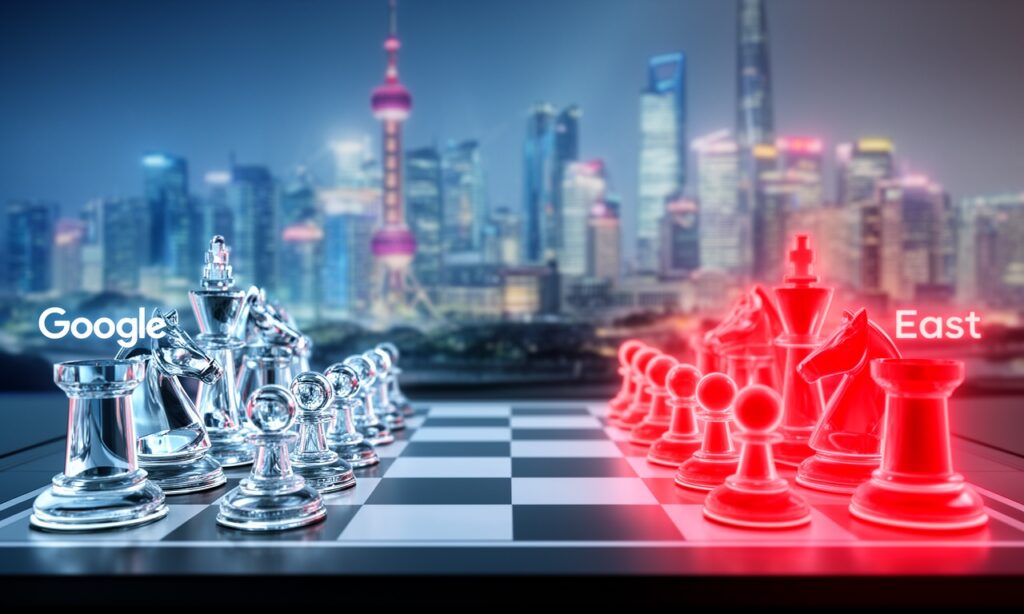
The narrative of Western AI dominance faces a massive caveat: DeepSeek. This Chinese AI lab has disrupted the market by releasing models like DeepSeek-V3.2, which demonstrate competitive performance at a fraction of the cost.
DeepSeek represents a “West vs. East” competition where the East focuses on hyper-efficiency and open-weight models. While Google and OpenAI build massive, closed-source “cathedrals” of intelligence, DeepSeek provides a “bazaar” of high-performance, low-cost alternatives. In coding and mathematics, DeepSeek-V3.2 is often a peer to Gemini 3, making it the primary choice for developers who prioritize cost-to-performance ratios. This creates a geopolitical split: the West owns the “Personal Intelligence” ecosystem, while the East may dominate the “Utility AI” market.
Google’s Path: Dominate or Disappear?
To capitalize on this dominance, Google must overcome its most famous internal demon: Product ADHD. Google has a history of launching brilliant tools only to abandon them (RIP Google Reader). To win, they must:
- Maintain Consistency: Ensure “Personal Intelligence” remains a core, stable pillar of the Android and Workspace experience.
- Solve the Trust Gap: As AI accesses more personal data, privacy must be more than a footnote; it must be the product’s primary selling point.
- Bridge to Enterprise: They must move these features into Google Workspace without compromising the strict security that businesses require.
If Google retreats into its old behavior of fragmented releases, a more focused player like OpenAI—or a more integrated one like Apple—could easily steal the “Personal Context” moat.
The Road to AGI and the “AI Bubble”
Are we on the verge of AGI (Artificial General Intelligence)? Gemini 3 is arguably the closest we’ve come, showing “PhD-level” reasoning in biology and physics. However, Google DeepMind CEO Demis Hassabis recently issued a sobering warning at Davos in January 2026. He noted that the AI investment landscape is becoming “bubble-like,” with valuations for some startups becoming detached from commercial reality.
Hassabis’s warning serves as a reality check: while the technology is accelerating, the market may face a correction. For Google, Gemini’s success is a hedge against this bubble. Because Gemini is built into products billions of people already use, its value isn’t speculative, it’s utility-based. This “product-first” AGI path puts Google in a stronger position than companies relying solely on API credits and hype.
Wrapping Up
Google’s “Personal Intelligence” rollout is a pivotal moment that transcends mere technical benchmarks. It is the first time an AI has been given the “keys to the house,” allowed to see our photos, read our mail, and anticipate our needs. By 2029, this level of integration will likely make the traditional Microsoft Office suite feel like a typewriter in a world of word processors. While the “AI Bubble” may burst for many, Google’s deep integration and the rise of efficient Eastern models like DeepSeek suggest that the era of truly personalized, ubiquitous intelligence is no longer a future prospect—it’s our new reality.

As President and Principal Analyst of the Enderle Group, Rob provides regional and global companies with guidance in how to create credible dialogue with the market, target customer needs, create new business opportunities, anticipate technology changes, select vendors and products, and practice zero dollar marketing. For over 20 years Rob has worked for and with companies like Microsoft, HP, IBM, Dell, Toshiba, Gateway, Sony, USAA, Texas Instruments, AMD, Intel, Credit Suisse First Boston, ROLM, and Siemens.
