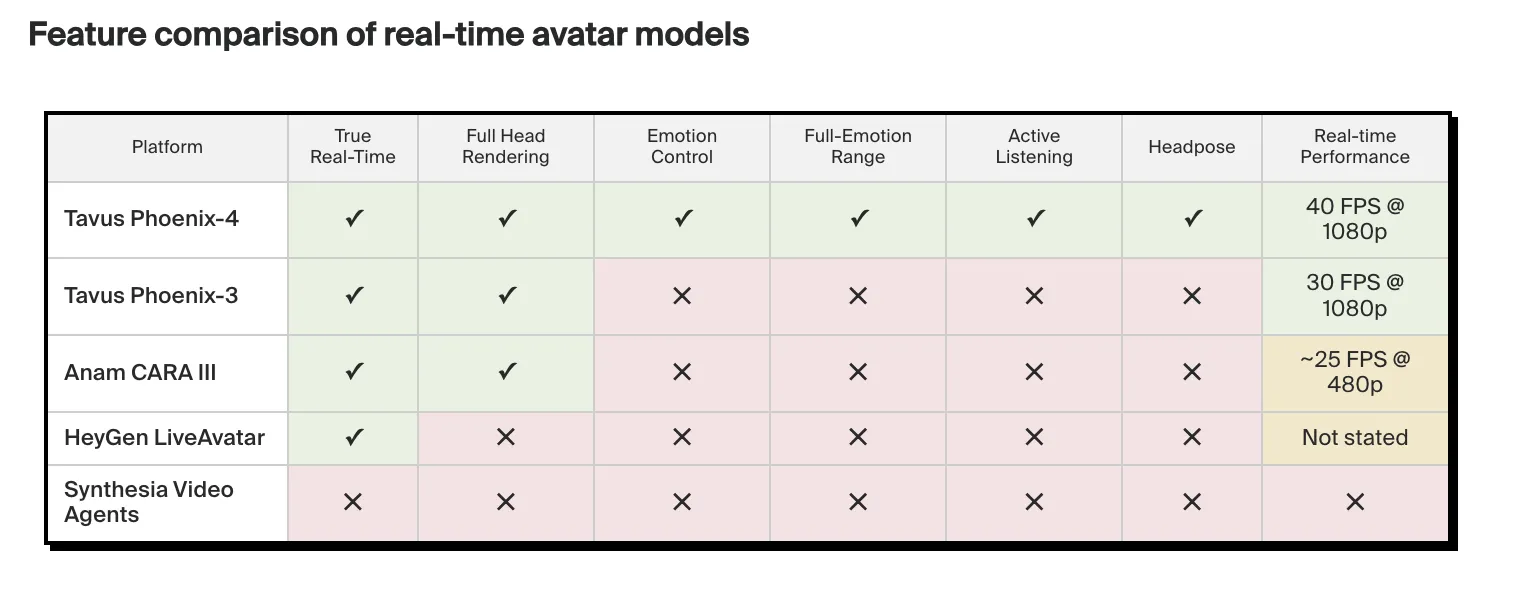
The ‘uncanny valley’ is the final frontier for generative video. We have seen AI avatars that can talk, but they often lack the soul of human interaction. They suffer from stiff movements and a lack of emotional context. Tavus aims to fix this with the launch of Phoenix-4, a new generative AI model designed for the Conversational Video Interface (CVI).
Phoenix-4 represents a shift from static video generation to dynamic, real-time human rendering. It is not just about moving lips; it is about creating a digital human that perceives, times, and reacts with emotional intelligence.
The Power of Three: Raven, Sparrow, and Phoenix
To achieve true realism, Tavus utilizes a 3-part model architecture. Understanding how these models interact is key for developers looking to build interactive agents.
- Raven-1 (Perception): This model acts as the ‘eyes and ears.’ It analyzes the user’s facial expressions and tone of voice to understand the emotional context of the conversation.
- Sparrow-1 (Timing): This model manages the flow of conversation. It determines when the AI should interrupt, pause, or wait for the user to finish, ensuring the interaction feels natural.
- Phoenix-4 (Rendering): The core rendering engine. It uses Gaussian-diffusion to synthesize photorealistic video in real-time.

Technical Breakthrough: Gaussian-Diffusion Rendering
Phoenix-4 moves away from traditional GAN-based approaches. Instead, it uses a proprietary Gaussian-diffusion rendering model. This allows the AI to calculate complex facial movements, such as the way skin stretching affects light or how micro-expressions appear around the eyes.
This means the model handles spatial consistency better than previous versions. If a digital human turns their head, the textures and lighting remain stable. The model generates these high-fidelity frames at a rate that supports 30 frames per second (fps) streaming, which is essential for maintaining the illusion of life.
Breaking the Latency Barrier: Sub-600ms
In a CVI, speed is everything. If the delay between a user speaking and the AI responding is too long, the ‘human’ feel is lost. Tavus has developed the Phoenix 4 pipeline to achieve an end-to-end conversational latency of sub-600ms.
This is achieved through a ‘stream-first’ architecture. The model uses WebRTC (Web Real-Time Communication) to stream video data directly to the client’s browser. Rather than generating a full video file and then playing it, Phoenix-4 renders and sends video packets incrementally. This ensures that the time to first frame is kept at an absolute minimum.
Programmatic Emotion Control
One of the most powerful features is the Emotion Control API. Developers can now explicitly define the emotional state of a Persona during a conversation.
By passing an emotion parameter in the API request, you can trigger specific behavioral outputs. The model currently supports primary emotional states including:
- Joy
- Sadness
- Anger
- Surprise
When the emotion is set to joy, the Phoenix-4 engine adjusts the facial geometry to create a genuine smile, affecting the cheeks and eyes, not just the mouth. This is a form of conditional video generation where the output is influenced by both the text-to-speech phonemes and an emotional vector.
Building with Replicas
Creating a custom ‘Replica’ (a digital twin) requires only 2 minutes of video footage for training. Once the training is complete, the Replica can be deployed via the Tavus CVI SDK.
The workflow is straightforward:
- Train: Upload 2 minutes of a person speaking to create a unique
replica_id. - Deploy: Use the
POST /conversationsendpoint to start a session. - Configure: Set the
persona_idand theconversation_name. - Connect: Link the provided WebRTC URL to your front-end video component.
Key Takeaways
- Gaussian-Diffusion Rendering: Phoenix-4 moves beyond traditional GANs to use Gaussian-diffusion, enabling high-fidelity, photorealistic facial movements and micro-expressions that solve the ‘uncanny valley’ problem.
- The AI Trinity (Raven, Sparrow, Phoenix): The architecture relies on three distinct models: Raven-1 for emotional perception, Sparrow-1 for conversational timing/turn-taking, and Phoenix-4 for the final video synthesis.
- Ultra-Low Latency: Optimized for the Conversational Video Interface (CVI), the model achieves sub-600ms end-to-end latency, utilizing WebRTC to stream video packets in real-time.
- Programmatic Emotion Control: You can use an Emotion Control API to specify states like joy, sadness, anger, or surprise, which dynamically adjusts the character’s facial geometry and expressions.
- Rapid Replica Training: Creating a custom digital twin (‘Replica’) is highly efficient, requiring only 2 minutes of video footage to train a unique identity for deployment via the Tavus SDK.
Check out the Technical details, Docs and Try it here. Also, feel free to follow us on Twitter and don’t forget to join our 100k+ ML SubReddit and Subscribe to our Newsletter. Wait! are you on telegram? now you can join us on telegram as well.